
Science
Interstellar Object 3I/ATLAS Defies Comet Theories as It Approaches Jupiter

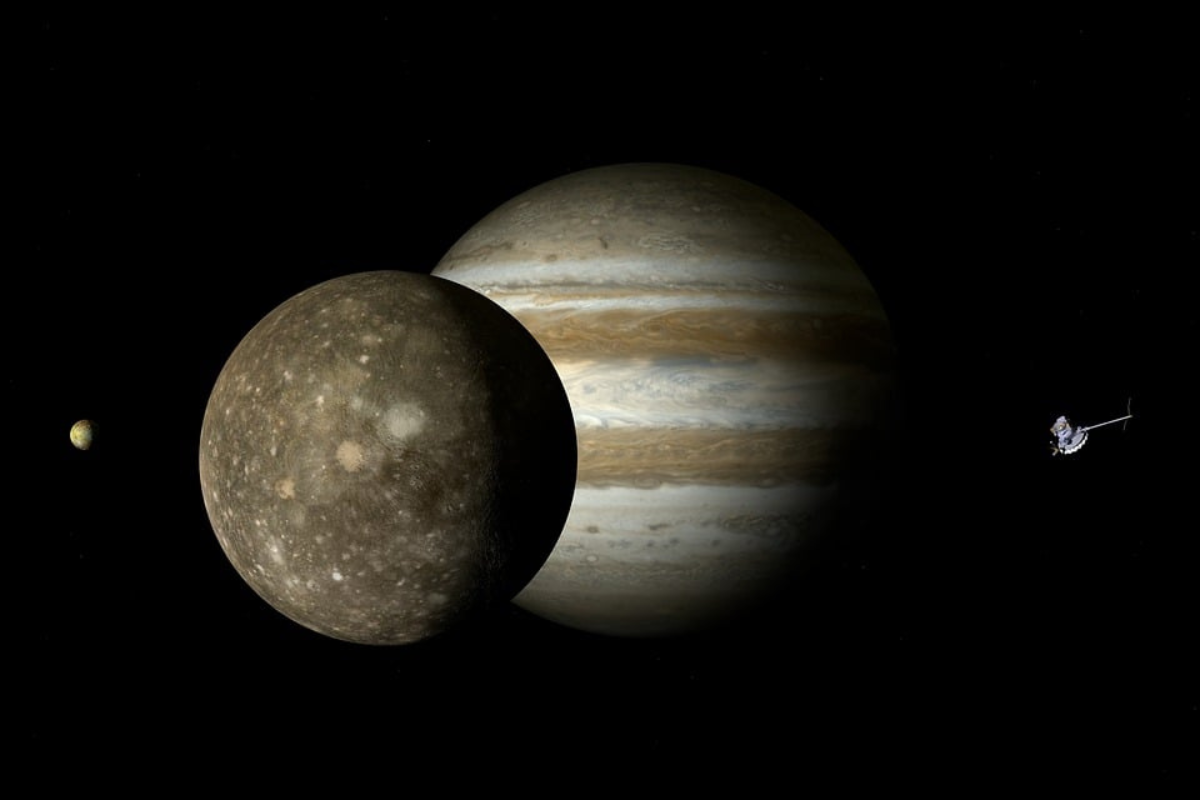
The interstellar object designated as 3I/ATLAS is exhibiting unexpected behavior as it makes its way toward Jupiter. Discovered on July 1, 2025, by the ATLAS survey telescope in Chile, this object is the third confirmed interstellar visitor, following 1I/ʻOumuamua and 2I/Borisov. Initially entering our solar system at a speed of approximately 44 km/s, it reached its closest point to the sun, known as perihelion, on October 29 or 30, 2025, at a distance of around 130 million miles (or 210 million km) from the sun.
As 3I/ATLAS moves on a retrograde trajectory, it is set to approach Jupiter closely in March 2026, at a distance of 0.357 AU (approximately 33 million miles or 53 million km). What is particularly intriguing about this interstellar visitor is how it is seemingly disintegrating — yet in a manner not typical of comets. Instead of the erratic outbursts usually seen when a comet’s ice and dust meet solar heat, 3I/ATLAS is releasing material steadily, raising questions about its underlying physical processes.
Recent observations from NASA, notably from the Parker Solar Probe’s WISPR instrument and the Neil Gehrels Swift Observatory, indicate that the activity around 3I/ATLAS has been primarily dominated by dust. Hydroxyl gas, a marker often associated with water, was detected, although the overall levels of water gas were low. Observations from Tenerife, Spain, using the Transient Survey Telescope and the Two-Meter Twin Telescope, have revealed that the object is shedding dust with remarkable precision, suggesting a more controlled mechanism than previously observed in comets.
The total mass loss from 3I/ATLAS over about a month is estimated at around ten million kilograms, with a dust production rate of about three kilograms per second. Unlike typical comets that exhibit explosive flares or chaotic breakups, 3I/ATLAS is characterized by a calm profile. This unusual behavior raises significant implications for current comet science.
In fact, data from Tenerife indicate a highly organized release of material. The observations show a pronounced sunward jet of gas and dust and emissions of cyanogen, alongside a distinct anti-tail formed by fine dust grains. This controlled release, akin to a slow hemorrhage, contrasts sharply with the expected chaotic behavior of standard comets.
The findings challenge existing comet models. Avi Loeb, a Harvard astrophysicist, notes that the peculiar anti-tail cannot be explained by the ultra-fine dust typically found in cometary comae, which would be quickly dispersed by sunlight. Instead, the data suggest that larger grains are not responsible either, as gas drag would struggle to accelerate those to the observed speeds. The evidence points to a significant quantity of dust grains about ten microns in size, which is rare in interstellar environments.
Further complicating the picture, precovery observations from the TESS spacecraft indicate that 3I/ATLAS was already active at a distance of 6.4 AU, with a nucleus size limit suggesting it is larger than previous interstellar objects. The consistency of the brightness and the defined orientation of the jet imply a stable and repeatable internal mechanism, which contrasts with the randomness usually associated with such celestial phenomena.
Despite the ongoing mass loss, there are no signs of rotational shedding or chaotic breakups, raising questions about the structural integrity of 3I/ATLAS. Observations from ground-based observatories have provided valuable data, yet higher-resolution images from space-based instruments capable of analyzing fine dust dynamics remain limited, leaving a gap in understanding the true nature of this interstellar object.
3I/ATLAS is expected to pass approximately 167 million miles from Earth on December 19, 2025, posing no threat to our planet. As it continues its journey, missions like the European Space Agency’s Comet Interceptor, scheduled for launch in 2029, are set to pursue future interstellar visitors.
While there is no implication that 3I/ATLAS is artificial, its anomalous behavior raises profound questions about the nature of interstellar wanderers. As this cosmic intrigue unfolds, the global astronomy community continues to monitor its path, encouraging public engagement through platforms like the International Astronomical Union’s Minor Planet Center. The observations of 3I/ATLAS may ultimately challenge long-standing assumptions regarding how interstellar bodies evolve and survive their journeys between the stars.













Belfast Gears Up for Vibrant St Patrick’s Day Parade on March 17

Cuba Faces Nationwide Blackout Amid Deepening Energy Crisis

Wirral Council to Restructure Leadership, Cutting Two Top Roles

Rethinking Resistance Training: Key Insights from US Experts

EU Membership on the Horizon: What It Means for Citizens

Ukrainian Drone Swarms Strike Moscow Region for Second Day

Henley Launches Innovative Initiative to Boost Local Economy

Court Ruling Allows Pandemic Tax Refund Claims Until 2026

Sean Penn’s Absence at 2026 Oscars Sparks Discussion

Coronation Street’s Shocking Murder Twist Reveals Family Secrets

Andrew Pierce Confirms Departure from ITV’s Good Morning Britain

Katie Price Faces New Health Concerns After Cancer Symptoms Resurface

Gyles Brandreth Shares Grandson’s Cancer Battle and Recovery

Sue Radford Reveals Weight Loss Journey, Shedding 12–13 kg

Kate Garraway Sells £2 Million Home Amid Financial Struggles

Jordan Brook Faces Health Crisis in Hospital as Sophie Kasaei Stays Away

EastEnders’ Nicola Mitchell Faces Unexpected Pregnancy Crisis

Reddit Study Reveals Distinctions Between Lurkers and Power Users
-
 World9 months ago
Coronation Street’s Shocking Murder Twist Reveals Family Secrets
-
 Entertainment9 months ago
Andrew Pierce Confirms Departure from ITV’s Good Morning Britain
-
 Health12 months ago
Katie Price Faces New Health Concerns After Cancer Symptoms Resurface
-
 Health7 months ago
Gyles Brandreth Shares Grandson’s Cancer Battle and Recovery
-
 Health7 months ago
Sue Radford Reveals Weight Loss Journey, Shedding 12–13 kg
-
 Entertainment1 year ago
Kate Garraway Sells £2 Million Home Amid Financial Struggles
-
 Entertainment5 months ago
Jordan Brook Faces Health Crisis in Hospital as Sophie Kasaei Stays Away
-
 World10 months ago
EastEnders’ Nicola Mitchell Faces Unexpected Pregnancy Crisis
-
 Science9 months ago
Reddit Study Reveals Distinctions Between Lurkers and Power Users
-

 World9 months ago
Mother Charged After Son, 9, Killed in Tragic Incident in Italy
-

 Entertainment12 months ago
Ann Ming Reflects on ITV’s ‘I Fought the Law’ Drama
-

 World9 months ago
Bailey Announces Heartbreaking Split from Rebecca After Reunion