
Science
Early Image of 3I/ATLAS Stirs Scientific Debate and Speculation

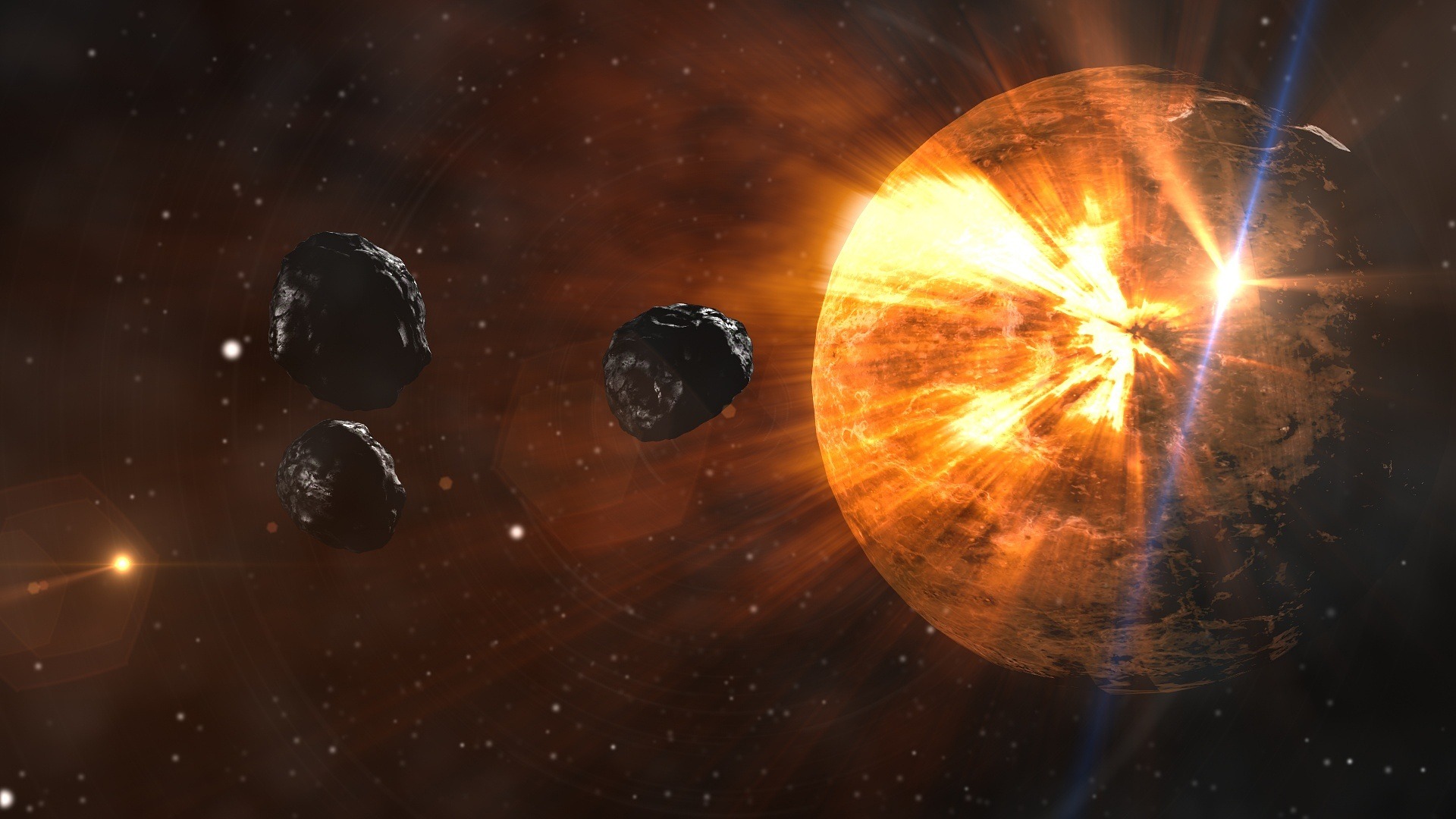
An early image of the interstellar object 3I/ATLAS has sparked significant debate and speculation among scientists regarding its unusual characteristics. Captured by ground-based telescopes shortly after the object’s discovery, this image displays a highly asymmetric light distribution that contrasts sharply with typical cometary appearances. Although subsequent observations by NASA show a more conventional cometary form, the initial image—with its strikingly lopsided glow—has raised questions about the object’s true nature.
The peculiarities of 3I/ATLAS have captured attention since its hyperbolic trajectory indicated an origin beyond the solar system. This classification has been confirmed through archival data from the Zwicky Transient Facility and follow-up imaging by various professional telescopes. Subsequent images from NASA assets, including the Hubble Space Telescope, the Solar and Heliospheric Observatory (SOHO), and the Mars Reconnaissance Orbiter, depict a comet with a typical coma and evidence of volatile outgassing as it approaches the Sun. Spectroscopic measurements have identified key compounds such as carbon dioxide and water vapor in the object’s coma.
Despite the professional consensus, the early image taken weeks prior to these observations remains contentious. Many astronomers initially dismissed the frame as an anomaly or exposure artifact, as it does not conform to the symmetric patterns expected from solar heating.
Debate Intensifies Over Unusual Characteristics
The controversy gained traction following comments from Avi Loeb, a Harvard astrophysicist who has advocated for a deeper examination of the object’s features. Loeb assigned a value of four on his proprietary Loeb scale, which rates the likelihood of an object being artificial, indicating that while largely consistent with natural explanations, 3I/ATLAS cannot be entirely dismissed.
In his analysis, Loeb pointed out several key factors: the object’s unusual orientation within the solar system, the asymmetry of the early image, and unexpected compositional signatures, including unusually high nickel readings. He has reiterated these points in numerous interviews, suggesting that there are gaps in NASA’s public data releases that warrant further scrutiny.
Despite Loeb’s assertions, mainstream scientific bodies have reaffirmed the object’s classification as a natural comet. NASA’s science teams have clarified that the observed features, including anti-tails and irregular jet structures, align with expected variations due to outgassing asymmetries and viewing geometry. Peer-reviewed publications have provided rigorous spectroscopic evidence supporting the presence of both water and carbon dioxide, reinforcing the classification of 3I/ATLAS as a comet with complex yet explainable behavior.
Misinformation and Public Discourse
Public discussions surrounding 3I/ATLAS have been complicated by misinformation and speculative claims. Deepfake videos falsely attributing quotes about the object to prominent physicists, including Michio Kaku, have been disavowed by those scientists, who have clarified their positions on the object’s characteristics. The online discourse has highlighted the challenge of distinguishing verified scientific findings from viral speculation, with amateur communities struggling to differentiate credible sources from conjecture.
On November 19, 2025, NASA and allied agencies released new images that provided a clearer understanding of the object’s behavior, showing a characteristic coma and a trajectory consistent with its hyperbolic interstellar passage. Experts agree that 3I/ATLAS does not pose any threat to Earth, affirming its status as an extraordinary natural visitor from beyond the solar system.
The ongoing discussion emphasizes the importance of clear communication in science, particularly in an era where misinformation can easily proliferate. As researchers continue to study 3I/ATLAS, the interplay between public curiosity and scientific rigor remains a focal point in the exploration of interstellar objects.






Belfast Gears Up for Vibrant St Patrick’s Day Parade on March 17

Cuba Faces Nationwide Blackout Amid Deepening Energy Crisis

Wirral Council to Restructure Leadership, Cutting Two Top Roles

Rethinking Resistance Training: Key Insights from US Experts

EU Membership on the Horizon: What It Means for Citizens

Ukrainian Drone Swarms Strike Moscow Region for Second Day

Henley Launches Innovative Initiative to Boost Local Economy

Court Ruling Allows Pandemic Tax Refund Claims Until 2026

Sean Penn’s Absence at 2026 Oscars Sparks Discussion

Coronation Street’s Shocking Murder Twist Reveals Family Secrets

Andrew Pierce Confirms Departure from ITV’s Good Morning Britain

Katie Price Faces New Health Concerns After Cancer Symptoms Resurface

Gyles Brandreth Shares Grandson’s Cancer Battle and Recovery

Sue Radford Reveals Weight Loss Journey, Shedding 12–13 kg

Kate Garraway Sells £2 Million Home Amid Financial Struggles

Jordan Brook Faces Health Crisis in Hospital as Sophie Kasaei Stays Away

EastEnders’ Nicola Mitchell Faces Unexpected Pregnancy Crisis

Reddit Study Reveals Distinctions Between Lurkers and Power Users
-
 World8 months ago
Coronation Street’s Shocking Murder Twist Reveals Family Secrets
-
 Entertainment8 months ago
Andrew Pierce Confirms Departure from ITV’s Good Morning Britain
-
 Health11 months ago
Katie Price Faces New Health Concerns After Cancer Symptoms Resurface
-
 Health6 months ago
Gyles Brandreth Shares Grandson’s Cancer Battle and Recovery
-
 Health6 months ago
Sue Radford Reveals Weight Loss Journey, Shedding 12–13 kg
-
 Entertainment12 months ago
Kate Garraway Sells £2 Million Home Amid Financial Struggles
-
 Entertainment5 months ago
Jordan Brook Faces Health Crisis in Hospital as Sophie Kasaei Stays Away
-
 World9 months ago
EastEnders’ Nicola Mitchell Faces Unexpected Pregnancy Crisis
-
 Science8 months ago
Reddit Study Reveals Distinctions Between Lurkers and Power Users
-

 World9 months ago
Mother Charged After Son, 9, Killed in Tragic Incident in Italy
-

 Entertainment11 months ago
Ann Ming Reflects on ITV’s ‘I Fought the Law’ Drama
-

 World9 months ago
Bailey Announces Heartbreaking Split from Rebecca After Reunion