
Science
Implanted Electrodes Revolutionize Control of Prosthetic Hands

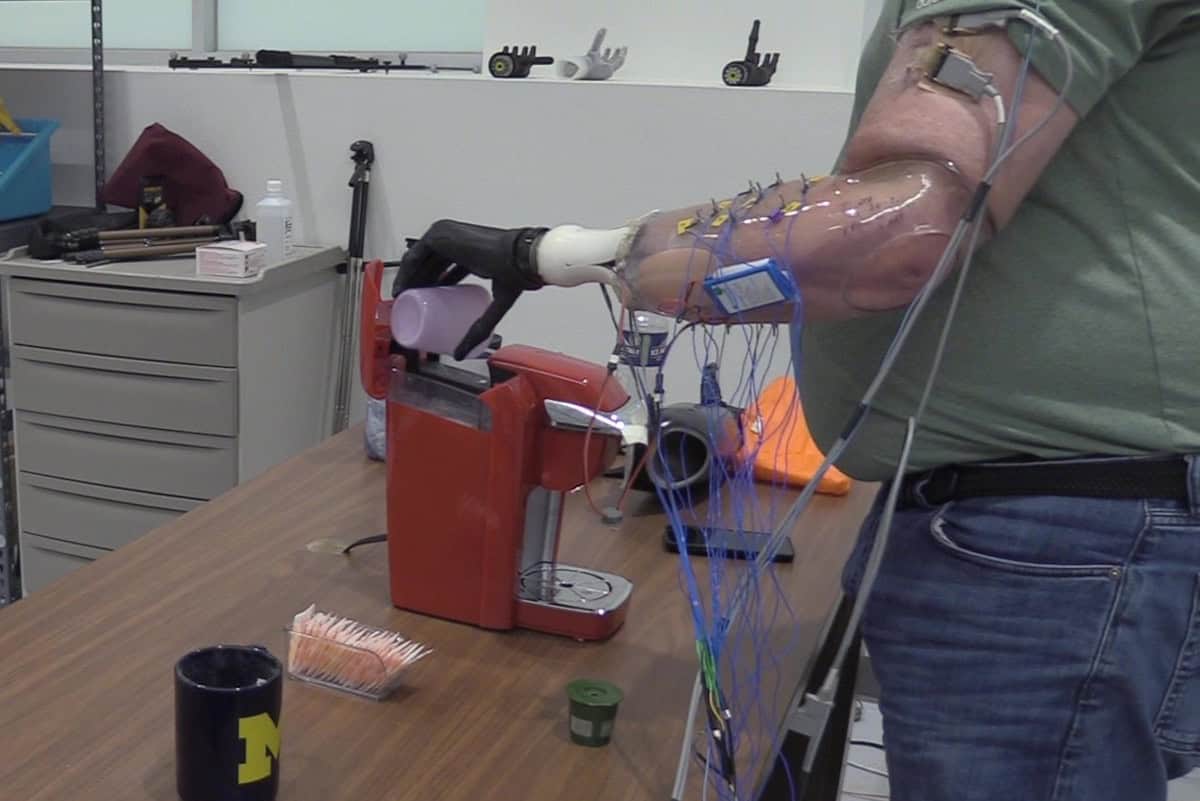
The use of implanted electrodes has emerged as a significant advancement in the control of prosthetic hands, offering enhanced functionality for individuals who have lost limbs. Researchers from the University of Michigan have demonstrated that these electrodes can provide more intuitive and reliable control of hand and wrist prostheses, addressing the limitations of traditional surface electrodes.
Current upper-limb prosthetics typically rely on surface electrodes that detect electrical signals from muscles beneath the skin. These signals, known as electromyography (EMG), are used to interpret movements. However, factors such as electrode positioning, limb volume changes, sweat, and user movement can compromise signal quality. In contrast, implanted electrodes, which are surgically integrated into the muscles, provide a more stable and accurate connection. By targeting deeper muscles in the arm, they significantly improve the signal-to-noise ratio and reduce susceptibility to variations in daily activities.
Cynthia Chestek, the senior author of the study published in the Journal of Neural Engineering, emphasized the advantages of using implanted electrodes. “Techniques like regenerative peripheral nerve interface (RPNI) surgery enable electrodes to access missing muscles, allowing for effective signal recording,” she noted. RPNI surgery involves grafting muscle tissue to nerves in the residual limb, which not only enhances prosthetic control but also helps prevent the formation of painful neuromas and may reduce phantom limb pain.
In their study, researchers examined the effectiveness of implanted electrodes in controlling prosthetic hand functions among two individuals with forearm amputations. Each participant had EMG electrodes implanted into their RPNIs and residual limb muscles. They engaged in various tasks, including controlling a virtual hand by mimicking movements displayed on a screen. The team recorded EMG signals from both the implanted and traditional surface electrodes for comparison.
During the experiments, the subjects demonstrated a marked improvement in performance using implanted electrodes. For instance, when participants remained still, the implanted electrodes achieved average accuracies of 82.1% and 91.2% for subjects one and two, respectively. In contrast, the surface electrodes yielded lower accuracies of 77.1% and 81.3% for gelled electrodes, and significantly lower for dry-domed electrodes, which recorded 58.2% and 67.1% respectively.
When the participants mimicked daily activities, the results indicated that the implanted electrodes maintained higher accuracy rates despite the added complexity of movement. The control success rate also experienced a decline in both scenarios, but the decrease was notably less significant for implanted electrodes. The researchers found that implanted electrodes produced stronger EMG signal amplitudes, less cross-correlation between channels, and smaller signal variations when transitioning from still to moving conditions.
To simulate a real-world scenario, one participant was tasked with the “Coffee Task.” This involved performing actions such as placing a cup into a coffee machine, inserting a coffee pod, and pouring sugar into the cup. The participant successfully completed the task faster using the implanted electrodes, achieving success in all three attempts. Conversely, when utilizing surface electrodes, they reached the time limit of 150 seconds in two out of three attempts.
While gelled electrodes are often considered the standard for surface EMG, they cannot be utilized with traditional prosthetic sockets. Dylan Wallace, the first author of the study, explained, “The physical prosthetic hand is essential for the Coffee Task, so it was only performed with dry-domed surface electrodes and implanted electrodes.”
The researchers also explored whether enabling simultaneous wrist and hand control could minimize compensatory body movements. Without wrist rotation, participants had to lean their upper bodies significantly to complete tasks. However, with wrist control activated, this movement was substantially reduced. Chestek noted that previous studies indicated that prosthetic users without active wrist control often needed to engage their entire upper body for simple tasks.
Looking ahead, the research team aims to develop continuous movement control for all joints of the hand, which represents a significant leap forward in prosthetic technology. While this objective presents challenges, the implications for improving the quality of life for amputees are profound.
The findings from this study underscore the potential of implanted electrodes to transform prosthetic technology, paving the way for more intuitive and functional solutions for individuals with limb loss.










Belfast Gears Up for Vibrant St Patrick’s Day Parade on March 17

Cuba Faces Nationwide Blackout Amid Deepening Energy Crisis

Wirral Council to Restructure Leadership, Cutting Two Top Roles

Rethinking Resistance Training: Key Insights from US Experts

EU Membership on the Horizon: What It Means for Citizens

Ukrainian Drone Swarms Strike Moscow Region for Second Day

Henley Launches Innovative Initiative to Boost Local Economy

Court Ruling Allows Pandemic Tax Refund Claims Until 2026

Sean Penn’s Absence at 2026 Oscars Sparks Discussion

Coronation Street’s Shocking Murder Twist Reveals Family Secrets

Andrew Pierce Confirms Departure from ITV’s Good Morning Britain

Katie Price Faces New Health Concerns After Cancer Symptoms Resurface

Gyles Brandreth Shares Grandson’s Cancer Battle and Recovery

Sue Radford Reveals Weight Loss Journey, Shedding 12–13 kg

Kate Garraway Sells £2 Million Home Amid Financial Struggles

Jordan Brook Faces Health Crisis in Hospital as Sophie Kasaei Stays Away

EastEnders’ Nicola Mitchell Faces Unexpected Pregnancy Crisis

Reddit Study Reveals Distinctions Between Lurkers and Power Users
-
 World8 months ago
Coronation Street’s Shocking Murder Twist Reveals Family Secrets
-
 Entertainment8 months ago
Andrew Pierce Confirms Departure from ITV’s Good Morning Britain
-
 Health12 months ago
Katie Price Faces New Health Concerns After Cancer Symptoms Resurface
-
 Health7 months ago
Gyles Brandreth Shares Grandson’s Cancer Battle and Recovery
-
 Health7 months ago
Sue Radford Reveals Weight Loss Journey, Shedding 12–13 kg
-
 Entertainment1 year ago
Kate Garraway Sells £2 Million Home Amid Financial Struggles
-
 Entertainment5 months ago
Jordan Brook Faces Health Crisis in Hospital as Sophie Kasaei Stays Away
-
 World10 months ago
EastEnders’ Nicola Mitchell Faces Unexpected Pregnancy Crisis
-
 Science8 months ago
Reddit Study Reveals Distinctions Between Lurkers and Power Users
-

 World9 months ago
Mother Charged After Son, 9, Killed in Tragic Incident in Italy
-

 Entertainment12 months ago
Ann Ming Reflects on ITV’s ‘I Fought the Law’ Drama
-

 World9 months ago
Bailey Announces Heartbreaking Split from Rebecca After Reunion