
Politics
The Gambia Takes Bold Action Against Myanmar for Rohingya Genocide

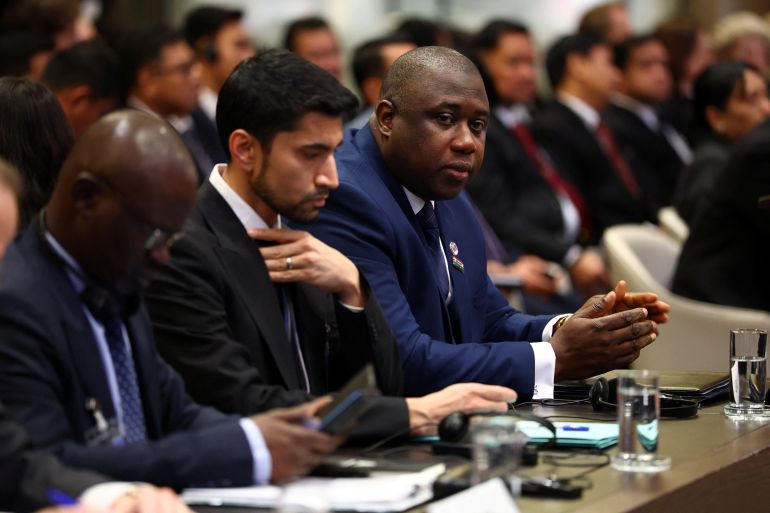
The Gambia has initiated a significant legal action against Myanmar, accusing the Southeast Asian nation of genocide against its Rohingya minority. The case began this week at the International Court of Justice (ICJ), with Gambia’s Attorney General and Justice Minister, Dawda A Jallow, asserting that the Rohingya have been “targeted for destruction” by the government of Myanmar. This landmark hearing follows nearly a decade after a military offensive displaced approximately 750,000 Rohingya, primarily into neighboring Bangladesh, where refugees have reported mass killings, sexual violence, and widespread destruction of their communities.
This case marks a historic moment as it is the first time allegations of mass violations against the Rohingya are being addressed in an international court. It is also the first instance where the ICJ is hearing a genocide case presented by one country on behalf of another nation or group. In a poignant gesture, Jallow invited Rohingya refugees present in the court’s Peace Hall to stand and be recognized by the panel of judges, reinforcing the human impact of the proceedings. The refugees are anticipated to provide testimony in closed sessions, although the timeline for a final ruling remains unclear. While the ICJ cannot enforce its decisions, its findings hold substantial legal significance.
The Gambia, a small West African nation with a population of 2.5 million, filed the case in November 2019, alleging that Myanmar had violated the 1948 Genocide Convention. Representing the 57-member Organisation for Islamic Cooperation, The Gambia’s actions have thrust it and its former Attorney General, Abubacarr Tambadou, into the global spotlight. Tambadou, who has since taken up a role at the United Nations, was nominated for the Nobel Peace Prize in 2021 for his efforts in this case. Support for The Gambia’s position has grown, with countries such as Canada, Denmark, the Netherlands, Germany, the Maldives, France, and Britain backing its claims at the ICJ.
The Rohingya have faced systematic violence from Myanmar’s military, known as the Tatmadaw, particularly since late 2016. Reports from rights organizations indicate that the military’s campaigns escalated dramatically during this period, leading to arson, mass shootings, rapes, and kidnappings. In 2019, a United Nations fact-finding mission reported that around 10,000 people had been killed and over 730,000 displaced due to the military’s actions. The UN concluded that the government sought to “erase” Rohingya identity, which lent credence to The Gambia’s claims of genocidal intent.
The Gambia’s motivations may be influenced by its own historical context of repression under former dictator Yahya Jammeh, who ruled from 1994 until his ousting in 2017. After Jammeh’s regime, the new government began addressing human rights abuses, prompting a collective reckoning among Gambians. As the Rohingya crisis unfolded, many in The Gambia felt a kinship with the suffering of the Rohingya, as they were undergoing their own truth-and-reconciliation process. Barrister Imran Darboe noted that Gambians recognized the universality of human rights and empathized with the Rohingya plight.
In his opening statements at the ICJ, Jallow detailed the horrific conditions faced by the Rohingya, stating, “They have been targeted for destruction.” He emphasized that Myanmar has denied the Rohingya their hopes and subjected them to unimaginable violence. Colleague Paul Reichler highlighted harrowing witness accounts from 2017, describing horrific acts of violence. Another team member, Philippe Sands, argued that the scale of violence indicated clear genocidal intent from Myanmar.
Myanmar’s defense will begin its response to the allegations, with the country’s Minister of International Cooperation, Ko Ko Hlaing, leading the legal team. The military, which assumed control after a coup in 2021, continues to reject claims of genocide and ethnic cleansing, asserting that their operations were aimed at combating Rohingya armed groups.
The Rohingya people, primarily based in Myanmar’s western Rakhine State, have long been marginalized and denied citizenship. While they identify as Indigenous to Myanmar, the government classifies them as “illegal migrants” from Bangladesh. Following the military’s offensive, around one million Rohingya have sought refuge in Bangladesh, India, Pakistan, and beyond. Conditions in refugee camps, particularly in Cox’s Bazar, remain dire, with many relying on humanitarian aid. Recent cuts to foreign assistance have exacerbated the situation, leading to reduced food supplies and the closure of schools.
As The Gambia’s case unfolds, the implications could extend beyond the Rohingya, potentially influencing other international legal actions, including a recent genocide case against Israel regarding Palestinians. The outcome at the ICJ may resonate widely, shaping future discussions on human rights and accountability across the globe.







Belfast Gears Up for Vibrant St Patrick’s Day Parade on March 17

Cuba Faces Nationwide Blackout Amid Deepening Energy Crisis

Wirral Council to Restructure Leadership, Cutting Two Top Roles

Rethinking Resistance Training: Key Insights from US Experts

EU Membership on the Horizon: What It Means for Citizens

Ukrainian Drone Swarms Strike Moscow Region for Second Day

Henley Launches Innovative Initiative to Boost Local Economy

Court Ruling Allows Pandemic Tax Refund Claims Until 2026

Sean Penn’s Absence at 2026 Oscars Sparks Discussion

Coronation Street’s Shocking Murder Twist Reveals Family Secrets

Andrew Pierce Confirms Departure from ITV’s Good Morning Britain

Katie Price Faces New Health Concerns After Cancer Symptoms Resurface

Gyles Brandreth Shares Grandson’s Cancer Battle and Recovery

Sue Radford Reveals Weight Loss Journey, Shedding 12–13 kg

Kate Garraway Sells £2 Million Home Amid Financial Struggles

Jordan Brook Faces Health Crisis in Hospital as Sophie Kasaei Stays Away

EastEnders’ Nicola Mitchell Faces Unexpected Pregnancy Crisis

Reddit Study Reveals Distinctions Between Lurkers and Power Users
-
 World8 months ago
Coronation Street’s Shocking Murder Twist Reveals Family Secrets
-
 Entertainment8 months ago
Andrew Pierce Confirms Departure from ITV’s Good Morning Britain
-
 Health11 months ago
Katie Price Faces New Health Concerns After Cancer Symptoms Resurface
-
 Health6 months ago
Gyles Brandreth Shares Grandson’s Cancer Battle and Recovery
-
 Health6 months ago
Sue Radford Reveals Weight Loss Journey, Shedding 12–13 kg
-
 Entertainment12 months ago
Kate Garraway Sells £2 Million Home Amid Financial Struggles
-
 Entertainment5 months ago
Jordan Brook Faces Health Crisis in Hospital as Sophie Kasaei Stays Away
-
 World9 months ago
EastEnders’ Nicola Mitchell Faces Unexpected Pregnancy Crisis
-
 Science8 months ago
Reddit Study Reveals Distinctions Between Lurkers and Power Users
-

 World9 months ago
Mother Charged After Son, 9, Killed in Tragic Incident in Italy
-

 Entertainment11 months ago
Ann Ming Reflects on ITV’s ‘I Fought the Law’ Drama
-

 World9 months ago
Bailey Announces Heartbreaking Split from Rebecca After Reunion