
World
Iconic Architect Frank Gehry Passes Away at 96, Leaving Legacy

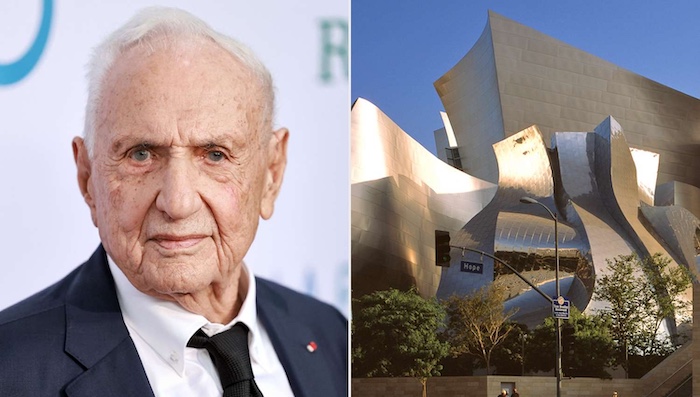
Frank Gehry, the renowned architect celebrated for his innovative and sculptural designs, has died at the age of 96. His passing was confirmed by his chief of staff, Meaghan Lloyd, on March 28, 2023. Gehry’s work significantly influenced modern architecture, with his most notable achievement being the Guggenheim Museum in Bilbao, Spain, which opened in 1997 and is often credited with revitalizing the city’s economy through what is known as the “Bilbao effect.”
Born in Toronto in 1929, Gehry moved to Los Angeles as a teenager, where he pursued his architectural studies at the University of Southern California. He later completed postgraduate work at Harvard’s Graduate School of Design. Gehry established his own practice, quickly distinguishing himself from traditional architectural norms by embracing asymmetry, unconventional materials, and raw surfaces. This innovative approach later evolved into what is known as deconstructivism.
His breakthrough came when he transformed his Santa Monica home using materials such as chain-link fencing and corrugated metal. Gehry’s use of advanced 3D modelling techniques, adapted from aerospace engineering, enabled him to create sweeping, curvaceous structures that were previously thought to be impossible.
In recognition of his contributions to the field, Gehry received the prestigious Pritzker Prize in 1989. The award jury commended his “highly refined, sophisticated and adventurous aesthetic,” likening his work to jazz for its improvisatory qualities. Gehry’s designs became landmarks across the globe, including the Walt Disney Concert Hall in Los Angeles, the Jay Pritzker Pavilion in Chicago, the Gehry Tower in Germany, the Louis Vuitton Foundation in Paris, the Dancing House in Prague, and the Hotel Marqués de Riscal in Spain.
The Guggenheim Museum in Bilbao, constructed from titanium, glass, and limestone, remains one of the greatest architectural achievements of the modern era. Architect Philip Johnson once hailed it as “the greatest building of our time.” Gehry’s distinctive style, characterized by fluid and unpredictable designs, captured public imagination and, at times, became the subject of parody. His appearance on The Simpsons, where a crumpled piece of paper supposedly inspires a building design, became a cultural reference point that he admitted “haunted” him, despite the complexities behind his actual work.
Tributes have poured in from various corners of the world following his death. Bernard Arnault, CEO of LVMH, referred to Gehry’s Paris building as “his greatest masterpiece.” Author and architecture critic Paul Goldberger remarked that Gehry was “one of the few architects to engage people emotionally,” noting that he continued to work with full creative energy until the end.
Canadian Prime Minister Mark Carney extended condolences to Gehry’s family, stating that his vision “lives on in iconic buildings around the world.” The Guggenheim Museum in Bilbao also paid tribute to Gehry, asserting that his legacy “will always remain connected to Bilbao.”
Gehry is survived by his wife, Berta Isabel Aguilera; two daughters from his first marriage, Leslie and Brina; and two sons, Alejandro and Samuel. His passing marks the end of an era for architecture, yet his influence will endure through the transformative impact of his work on cities and communities worldwide.









Belfast Gears Up for Vibrant St Patrick’s Day Parade on March 17

Cuba Faces Nationwide Blackout Amid Deepening Energy Crisis

Wirral Council to Restructure Leadership, Cutting Two Top Roles

Rethinking Resistance Training: Key Insights from US Experts

EU Membership on the Horizon: What It Means for Citizens

Ukrainian Drone Swarms Strike Moscow Region for Second Day

Henley Launches Innovative Initiative to Boost Local Economy

Court Ruling Allows Pandemic Tax Refund Claims Until 2026

Sean Penn’s Absence at 2026 Oscars Sparks Discussion

Coronation Street’s Shocking Murder Twist Reveals Family Secrets

Andrew Pierce Confirms Departure from ITV’s Good Morning Britain

Katie Price Faces New Health Concerns After Cancer Symptoms Resurface

Sue Radford Reveals Weight Loss Journey, Shedding 12–13 kg

Kate Garraway Sells £2 Million Home Amid Financial Struggles

Jordan Brook Faces Health Crisis in Hospital as Sophie Kasaei Stays Away

EastEnders’ Nicola Mitchell Faces Unexpected Pregnancy Crisis

Bailey Announces Heartbreaking Split from Rebecca After Reunion

Ann Ming Reflects on ITV’s ‘I Fought the Law’ Drama
-
 World4 months ago
Coronation Street’s Shocking Murder Twist Reveals Family Secrets
-
 Entertainment4 months ago
Andrew Pierce Confirms Departure from ITV’s Good Morning Britain
-
 Health7 months ago
Katie Price Faces New Health Concerns After Cancer Symptoms Resurface
-
 Health3 months ago
Sue Radford Reveals Weight Loss Journey, Shedding 12–13 kg
-
 Entertainment8 months ago
Kate Garraway Sells £2 Million Home Amid Financial Struggles
-
 Entertainment4 weeks ago
Jordan Brook Faces Health Crisis in Hospital as Sophie Kasaei Stays Away
-
 World5 months ago
EastEnders’ Nicola Mitchell Faces Unexpected Pregnancy Crisis
-
 World5 months ago
Bailey Announces Heartbreaking Split from Rebecca After Reunion
-
 Entertainment7 months ago
Ann Ming Reflects on ITV’s ‘I Fought the Law’ Drama
-

 Entertainment2 months ago
Selena Gomez’s Name Linked to Epstein: Examining the Claims
-

 Health7 months ago
TOWIE Stars Sophie Kasaei and Jordan Brook Pursue Fertility Treatment
-

 Health8 months ago
Fiona Phillips’ Husband Shares Heartbreaking Update on Her Health