
World
Gaza Children Return to Classes After Nearly Two Years of Disruption

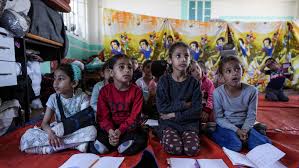
In Gaza City, children have resumed classes for the first time in nearly two years, following a ceasefire between Israel and Hamas in October 2023. The pupils are now attending lessons inside tents set up in the ruins of the Lulwa Abdel Wahab al-Qatami School, located in the Tel al-Hawa area of south-west Gaza City. The school was severely damaged by Israeli air strikes in January 2024 and later served as a shelter for displaced families. Now, it has been transformed into a temporary learning centre.
Teachers are using makeshift boards to write English letters and basic Arabic words as children gather in the tents, marking an important but fragile return to routine after extensive disruption. According to UNICEF, over 97 percent of schools in Gaza were either damaged or destroyed during the conflict, leaving around 658,000 school-aged children without formal education for nearly two years. Many of these children faced challenges such as hunger, displacement, and the loss of family members during this period.
Fourteen-year-old Naeem al-Asmaar, who was a previous student at the Lulwa school, shared that returning to classes has brought back a sense of normalcy. He tragically lost his mother in an Israeli air strike. “It was the hardest thing I’ve ever been through,” he said quietly. “Before the war, school was in real classrooms. Now it’s tents. We study only four subjects and there isn’t enough space, but being here matters.”
Another student, Rital Alaa Harb, a ninth-grader aspiring to become a dentist, expressed how the war disrupted her education. “There was no time to study, no schools. I missed my friends and my old school,” she stated. The temporary school, operated by UNICEF, accommodates children from the original Lulwa school as well as others who have been displaced by the fighting. Lessons are currently limited to Arabic, English, mathematics, and science, which does not cover the full Palestinian curriculum.
Dr Mohammed Saeed Schheiber, the school’s principal with over 24 years of experience in education, noted that the initiative aims to help students recover lost learning time. “We started with determination to compensate students for what they lost,” he said. The facility now caters to approximately 1,100 pupils across three daily shifts, with boys and girls attending on alternating days. Currently, only 24 teachers are available, and the school operates without electricity, internet access, or essential educational resources.
Dr Schheiber highlighted the widespread impact of the war on students, noting that over 100 children have lost one or both parents, had their homes destroyed, or witnessed killings. While a counsellor provides psychological support, the demand greatly exceeds available capacity. “There is a large displacement camp next to the school,” he explained. “Many children want to enrol, but we simply cannot take them.”
Parents have expressed mixed feelings about the return to school, experiencing both relief and anxiety. Huda Bassam al-Dasouki, a mother of five displaced from southern Rimal, conveyed the challenges of education due to shortages and rising costs. “A notebook that cost one shekel before the war now costs five,” she said. “Some children have fallen four years behind. My son can’t read or write properly.”
UNICEF has reported that restrictions on aid entering Gaza have further exacerbated the situation. Its spokesman, Jonathan Crickx, stated that essential school supplies and mental health kits remain largely unavailable. “Paper, notebooks, pens, and recreational kits for psychosocial support have not been allowed in,” he noted. While Israel claims to be meeting its obligations under the ceasefire and facilitating increased aid deliveries, this assertion has been disputed by the United Nations and various humanitarian agencies.
Despite ongoing challenges, including the continuation of Israeli air strikes citing alleged Hamas violations, children persist in attending classes. For teacher Kholoud Habib, their resilience underscores the value that Palestinians place on education. “We lose homes, money, and everything else,” she remarked. “But knowledge is the one investment we can still give our children.”










Belfast Gears Up for Vibrant St Patrick’s Day Parade on March 17

Cuba Faces Nationwide Blackout Amid Deepening Energy Crisis

Wirral Council to Restructure Leadership, Cutting Two Top Roles

Rethinking Resistance Training: Key Insights from US Experts

EU Membership on the Horizon: What It Means for Citizens

Ukrainian Drone Swarms Strike Moscow Region for Second Day

Henley Launches Innovative Initiative to Boost Local Economy

Court Ruling Allows Pandemic Tax Refund Claims Until 2026

Sean Penn’s Absence at 2026 Oscars Sparks Discussion

Coronation Street’s Shocking Murder Twist Reveals Family Secrets

Andrew Pierce Confirms Departure from ITV’s Good Morning Britain

Katie Price Faces New Health Concerns After Cancer Symptoms Resurface

Sue Radford Reveals Weight Loss Journey, Shedding 12–13 kg

Kate Garraway Sells £2 Million Home Amid Financial Struggles

Jordan Brook Faces Health Crisis in Hospital as Sophie Kasaei Stays Away

EastEnders’ Nicola Mitchell Faces Unexpected Pregnancy Crisis

Bailey Announces Heartbreaking Split from Rebecca After Reunion

Ann Ming Reflects on ITV’s ‘I Fought the Law’ Drama
-
 World4 months ago
Coronation Street’s Shocking Murder Twist Reveals Family Secrets
-
 Entertainment4 months ago
Andrew Pierce Confirms Departure from ITV’s Good Morning Britain
-
 Health7 months ago
Katie Price Faces New Health Concerns After Cancer Symptoms Resurface
-
 Health2 months ago
Sue Radford Reveals Weight Loss Journey, Shedding 12–13 kg
-
 Entertainment8 months ago
Kate Garraway Sells £2 Million Home Amid Financial Struggles
-
 Entertainment3 weeks ago
Jordan Brook Faces Health Crisis in Hospital as Sophie Kasaei Stays Away
-
 World5 months ago
EastEnders’ Nicola Mitchell Faces Unexpected Pregnancy Crisis
-
 World5 months ago
Bailey Announces Heartbreaking Split from Rebecca After Reunion
-
 Entertainment7 months ago
Ann Ming Reflects on ITV’s ‘I Fought the Law’ Drama
-

 Entertainment2 months ago
Selena Gomez’s Name Linked to Epstein: Examining the Claims
-

 Health7 months ago
TOWIE Stars Sophie Kasaei and Jordan Brook Pursue Fertility Treatment
-

 Health7 months ago
Fiona Phillips’ Husband Shares Heartbreaking Update on Her Health