
Science
Researchers Break Quantum Boundaries with Record-Setting Cat State

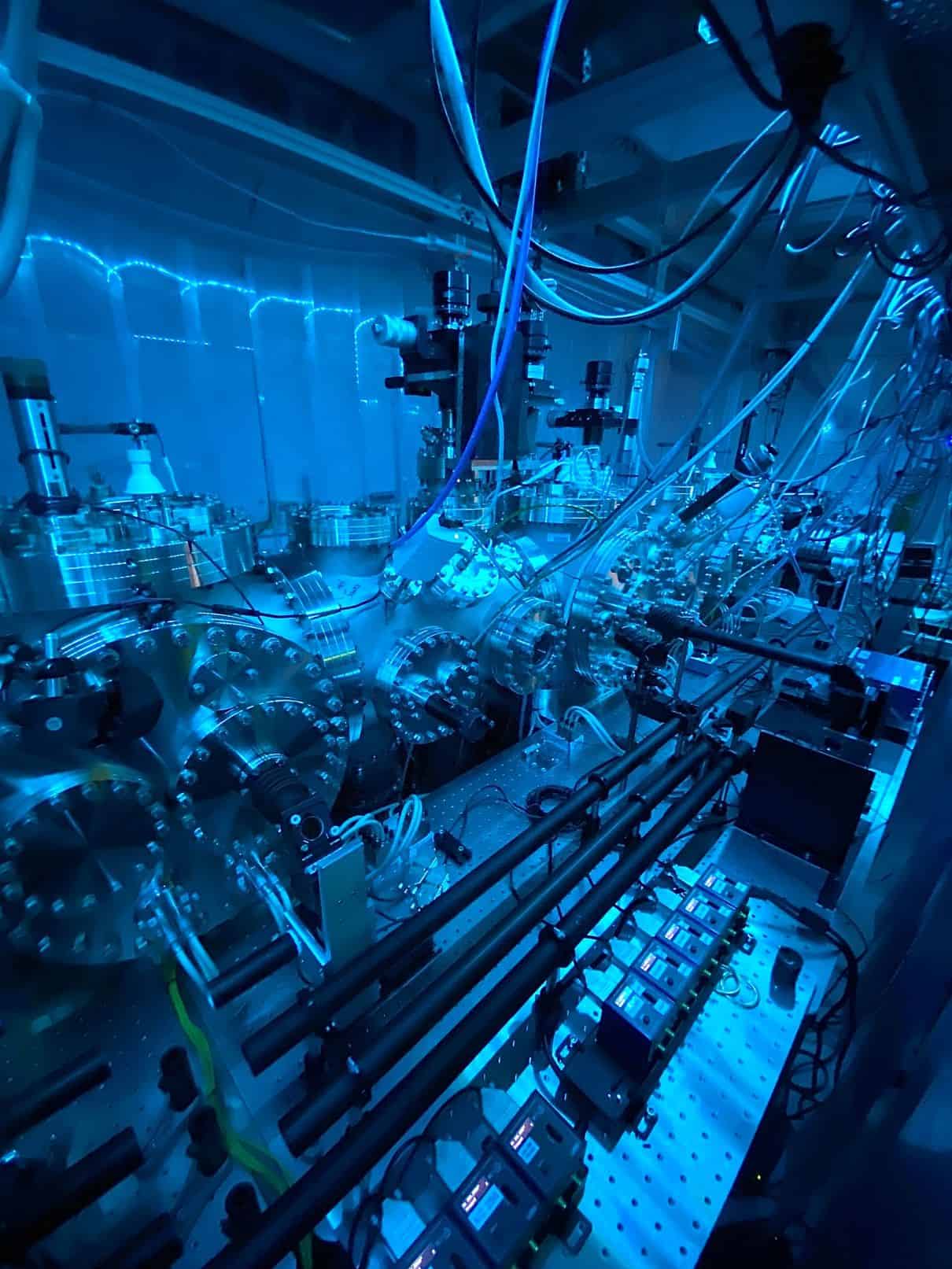
A team of researchers from Austria and Germany has made significant strides in quantum mechanics by successfully demonstrating that large metal nanoparticles continue to exhibit quantum behavior, even at macroscopic scales. This breakthrough, which involves particles weighing over 170,000 atomic mass units, challenges existing boundaries between quantum and classical physics.
Led by Sebastian Pedalino, a PhD student at the University of Vienna, the research showcases that clusters of sodium atoms can behave in line with quantum mechanics, even when composed of thousands of atoms. The findings were published in the journal Nature, marking a vital step in understanding the transition from the quantum realm to classical physics.
Experiment Details and Findings
The research team, which included Markus Arndt and Stefan Gerlich, collaborated with Klaus Hornberger from the University of Duisburg-Essen. They conducted experiments at a temperature of 77 K in an ultrahigh vacuum environment. The team created clusters containing between 5,000 and 10,000 atoms, which traveled at velocities of approximately 160 m/s. This resulted in de Broglie wavelengths measuring between 10⁻²² femtometers.
To observe the quantum effects, the researchers utilized a sophisticated interferometer setup featuring three diffraction gratings arranged in a Talbot–Lau configuration. The first grating directed the clusters through narrow openings, allowing their wave functions to expand. The second grating modulated the resulting wave, leading to interference patterns observable at the third grating. This pattern indicates that the clusters did not have a fixed location as they passed through the apparatus; instead, they existed in a superposition of multiple locations.
This phenomenon is reminiscent of the famous thought experiment by physicist Erwin Schrödinger, wherein a cat is simultaneously alive and dead until observed, hence the term “Schrödinger cat state.”
Implications and Future Research
The researchers quantified their achievement using a metric known as “macroscopicity,” which assesses the coherence time, mass, and separation of states within the quantum system. Their experiment achieved a macroscopicity value of 15.5, significantly surpassing previous records. According to Arndt, this milestone reflects the ongoing efforts of their long-term research program aimed at exploring the limits of quantum mechanics and testing its validity at higher masses.
While there are theories suggesting potential modifications to quantum mechanics, Arndt emphasizes the importance of remaining open-minded as experimentalists. He notes that the sensitivity of their machine to small forces could lead to new methods for characterizing material properties and possibly even discovering new particles in future research.
Despite expressing amazement at the behavior of these mesoscopic objects, Arndt acknowledges that understanding the implications of their findings remains a complex challenge. He highlights the need to decipher the duality between the delocalization observed in their experiments and the seemingly localized nature of measurement.
Looking ahead, the research team plans to extend their studies to explore higher mass objects, longer coherence times, and different materials, including nanobiological substances. “We still have a lot of work to do on sources, beam splitters, detectors, vibration isolation, and cooling,” Arndt remarked, indicating a promising path for continued exploration in this cutting-edge field of quantum science.










Belfast Gears Up for Vibrant St Patrick’s Day Parade on March 17

Cuba Faces Nationwide Blackout Amid Deepening Energy Crisis

Wirral Council to Restructure Leadership, Cutting Two Top Roles

Rethinking Resistance Training: Key Insights from US Experts

EU Membership on the Horizon: What It Means for Citizens

Ukrainian Drone Swarms Strike Moscow Region for Second Day

Henley Launches Innovative Initiative to Boost Local Economy

Court Ruling Allows Pandemic Tax Refund Claims Until 2026

Sean Penn’s Absence at 2026 Oscars Sparks Discussion

Coronation Street’s Shocking Murder Twist Reveals Family Secrets

Andrew Pierce Confirms Departure from ITV’s Good Morning Britain

Katie Price Faces New Health Concerns After Cancer Symptoms Resurface

Sue Radford Reveals Weight Loss Journey, Shedding 12–13 kg

Kate Garraway Sells £2 Million Home Amid Financial Struggles

Jordan Brook Faces Health Crisis in Hospital as Sophie Kasaei Stays Away

EastEnders’ Nicola Mitchell Faces Unexpected Pregnancy Crisis

Bailey Announces Heartbreaking Split from Rebecca After Reunion

Ann Ming Reflects on ITV’s ‘I Fought the Law’ Drama
-
 World4 months ago
Coronation Street’s Shocking Murder Twist Reveals Family Secrets
-
 Entertainment4 months ago
Andrew Pierce Confirms Departure from ITV’s Good Morning Britain
-
 Health7 months ago
Katie Price Faces New Health Concerns After Cancer Symptoms Resurface
-
 Health3 months ago
Sue Radford Reveals Weight Loss Journey, Shedding 12–13 kg
-
 Entertainment8 months ago
Kate Garraway Sells £2 Million Home Amid Financial Struggles
-
 Entertainment4 weeks ago
Jordan Brook Faces Health Crisis in Hospital as Sophie Kasaei Stays Away
-
 World5 months ago
EastEnders’ Nicola Mitchell Faces Unexpected Pregnancy Crisis
-
 World5 months ago
Bailey Announces Heartbreaking Split from Rebecca After Reunion
-
 Entertainment7 months ago
Ann Ming Reflects on ITV’s ‘I Fought the Law’ Drama
-

 Entertainment2 months ago
Selena Gomez’s Name Linked to Epstein: Examining the Claims
-

 Health7 months ago
TOWIE Stars Sophie Kasaei and Jordan Brook Pursue Fertility Treatment
-

 Health7 months ago
Fiona Phillips’ Husband Shares Heartbreaking Update on Her Health