
Science
Physicists Achieve Breakthrough in Acoustic Levitation of Multiple Objects

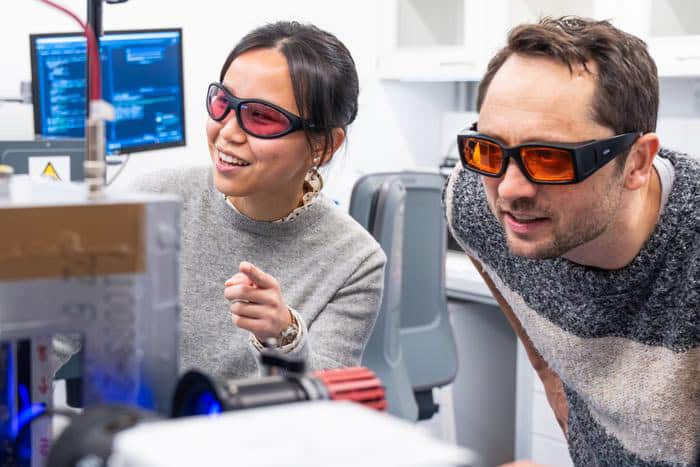
Research conducted by physicists at the Institute of Science and Technology Austria (ISTA) has successfully demonstrated a method to levitate multiple objects using sound waves, overcoming a significant challenge known as “acoustic collapse.” This breakthrough could have profound implications in fields such as acoustic-levitation-assisted 3D printing, chemical synthesis in mid-air, and advancements in micro-robotics.
The technique of acoustic levitation utilizes sound waves to lift small particles, typically ranging from tens of microns to several millimeters in size. While this method is effective for individual particles, the aggregation of multiple particles has long posed a problem. When sound waves scatter off several objects, the resulting acoustic forces can lead to attraction between them, causing them to clump together instead of remaining separate.
To address this issue, the ISTA team, led by Scott Waitukaitis, devised a solution that combines attractive acoustic forces with an adjustable repulsive electrostatic force. The researchers began their experiments by successfully levitating a single silver-coated poly(methyl methacrylate) (PMMA) microsphere measuring between 250 and 300 μm in diameter. This was achieved above a reflector plate that featured a transparent and conductive layer of indium tin oxide (ITO).
In the process, the particle was charged electrically by allowing it to rest on the ITO plate while the acoustic field was turned off. A high-voltage DC potential was applied between the plate and a transducer, resulting in a capacitive accumulation of charge on the particle. The charge amount could be estimated using Maxwell’s equations for two contacting conductive spheres.
The researchers then activated the acoustic field, and after a brief interval of just 10 milliseconds, they applied the electric field. If the electric field was sufficiently strong, it facilitated the particle’s movement toward the center of the levitation setup. Following this, the electric field was turned off. A few seconds later, the particle achieved stable levitation in the trap, with its charge aligning with theoretical predictions.
This innovative charging approach proved effective for multiple particles, allowing the researchers to introduce particles into the trap with high efficiency and control over their charge, limited only by the breakdown voltage of the surrounding air. The team found they could adjust the charge to keep particles separate or induce them to merge into a single, denser object. They even created hybrid states featuring both separated and collapsed particles.
Stunning Observations in Hybrid Structures
Among the most striking moments of the research was when Sue Shi, a PhD student at ISTA and lead author of the related paper published in the Proceedings of the National Academy of Sciences (PNAS), observed the compact parts of the hybrid structures beginning to rotate spontaneously. Meanwhile, the expanded sections remained stationary, oscillating in response to the rotation. Shi described this phenomenon as “a visually mesmerizing dance,” noting that it represented the first time such acoustically and electrostatically coupled interactions have been witnessed in an acoustically levitated system.
Beyond potential applications in materials science and micro-robotics, the technique developed by the ISTA team may facilitate the exploration of non-reciprocal effects that cause particles to rotate or oscillate. Shi indicated that understanding these complex non-reciprocal forces and many-body interactions could lead to significant advancements in the field.
The findings from this research not only advance the capabilities of acoustic levitation but also open new avenues for scientific inquiry in dynamics and particle interactions. As physicists continue to explore the implications of these breakthroughs, the potential for innovative applications in various industries remains vast.

Belfast Gears Up for Vibrant St Patrick’s Day Parade on March 17

Cuba Faces Nationwide Blackout Amid Deepening Energy Crisis

Wirral Council to Restructure Leadership, Cutting Two Top Roles

Rethinking Resistance Training: Key Insights from US Experts

EU Membership on the Horizon: What It Means for Citizens

Ukrainian Drone Swarms Strike Moscow Region for Second Day

Henley Launches Innovative Initiative to Boost Local Economy

Court Ruling Allows Pandemic Tax Refund Claims Until 2026

Sean Penn’s Absence at 2026 Oscars Sparks Discussion

Coronation Street’s Shocking Murder Twist Reveals Family Secrets

Andrew Pierce Confirms Departure from ITV’s Good Morning Britain

Katie Price Faces New Health Concerns After Cancer Symptoms Resurface

Sue Radford Reveals Weight Loss Journey, Shedding 12–13 kg

Kate Garraway Sells £2 Million Home Amid Financial Struggles

Jordan Brook Faces Health Crisis in Hospital as Sophie Kasaei Stays Away

EastEnders’ Nicola Mitchell Faces Unexpected Pregnancy Crisis

Bailey Announces Heartbreaking Split from Rebecca After Reunion

Ann Ming Reflects on ITV’s ‘I Fought the Law’ Drama
-
 World4 months ago
Coronation Street’s Shocking Murder Twist Reveals Family Secrets
-
 Entertainment4 months ago
Andrew Pierce Confirms Departure from ITV’s Good Morning Britain
-
 Health7 months ago
Katie Price Faces New Health Concerns After Cancer Symptoms Resurface
-
 Health3 months ago
Sue Radford Reveals Weight Loss Journey, Shedding 12–13 kg
-
 Entertainment8 months ago
Kate Garraway Sells £2 Million Home Amid Financial Struggles
-
 Entertainment4 weeks ago
Jordan Brook Faces Health Crisis in Hospital as Sophie Kasaei Stays Away
-
 World5 months ago
EastEnders’ Nicola Mitchell Faces Unexpected Pregnancy Crisis
-
 World5 months ago
Bailey Announces Heartbreaking Split from Rebecca After Reunion
-
 Entertainment7 months ago
Ann Ming Reflects on ITV’s ‘I Fought the Law’ Drama
-

 Entertainment2 months ago
Selena Gomez’s Name Linked to Epstein: Examining the Claims
-

 Health7 months ago
TOWIE Stars Sophie Kasaei and Jordan Brook Pursue Fertility Treatment
-

 Health8 months ago
Fiona Phillips’ Husband Shares Heartbreaking Update on Her Health