
Politics
Syria’s New Government Faces Challenges in Military Rebuilding

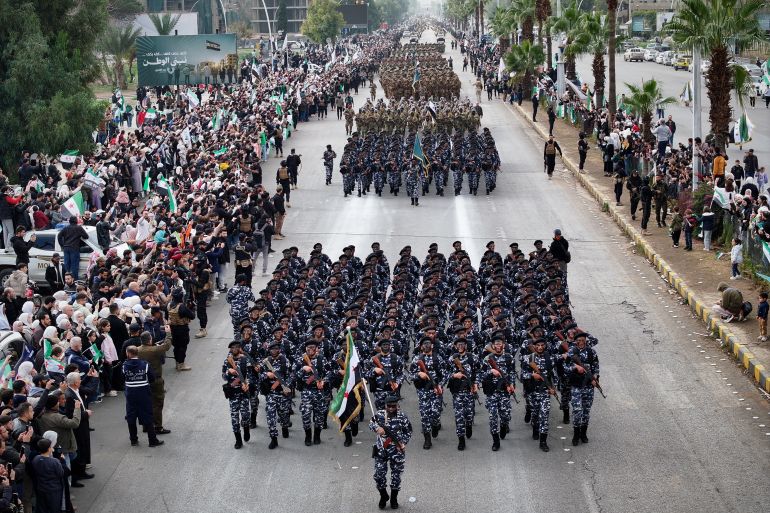
Syria is grappling with significant challenges as it embarks on the task of rebuilding its military and security forces following the fall of the regime led by Bashar al-Assad on December 8, 2024. The new government, under President Ahmed al-Sharaa, has prioritized the restructuring of the national army, aiming to shift its focus from a tool of repression to a protective force loyal to the country.
During a ceremony for soldiers graduating from a military academy in Aleppo, Murhaf Abu Qasra, the Defence Minister, emphasized the importance of developing a military that truly represents the nation. “We started the process of restructuring our military and army… and we are meeting the need of the moment by having an army that Syria deserves as a nation,” he stated. This initiative includes implementing rules of conduct and discipline to enhance military readiness.
Despite these efforts, analysts caution that the road to rebuilding the armed forces will be long and fraught with difficulties. A significant challenge will be altering the mindset of armed groups to integrate them into a cohesive, professional military structure. The new administration must also address the complexities of vetting recruits for the reformed security forces and navigating relationships with various factions, including the Syrian Democratic Forces (SDF) in the northeast.
The success of the Syrian armed forces is seen as crucial for establishing political stability in the country, which could facilitate foreign investment and support. Caroline Rose, Director of Military and National Security Priorities at the New Lines Institute, warns that failure to unify all armed factions could lead to fragmentation and potential civil conflict. “Without unification within its army and ongoing sectarian division, the country risks frequent security flashpoints,” she noted.
Following the collapse of the al-Assad regime, many in the military fled or turned in their weapons. Israel took advantage of the situation, launching extensive airstrikes that reportedly destroyed approximately 80 percent of Syria’s military capabilities shortly after al-Assad’s departure. In the past year alone, Israel has conducted over 600 attacks on Syrian territory.
The new administration has dissolved the former army, and al-Sharaa has appointed military commanders from factions that opposed al-Assad. This restructuring has led to the creation of a new security apparatus, with the Ministry of Defence overseeing the Syrian Armed Forces and the Ministry of Interior managing internal security forces. Recruitment efforts have opened to the general population, attracting tens of thousands of new recruits amid a dire economic situation.
Yet, the rapid pace of recruitment raises concerns over the vetting process. Many young men view military positions as one of the few available economic opportunities following years of conflict and sanctions. “It’s a very delicate balance to keep Syria’s security glued together,” said Samy Akil, a nonresident fellow at the Tahrir Institute. He expressed hopes that as time progresses, the government will be able to implement more rigorous vetting procedures.
The new government also faces the challenge of integrating foreign fighters who played prominent roles in the opposition against al-Assad. Western powers, particularly the United States, have issued clear warnings that foreign fighters must not hold key military positions. al-Sharaa has assured that these fighters will not pose any threat to their home countries.
Compounding these challenges is the presence of numerous former officers and noncommissioned officers with military training who have yet to be integrated into the new security framework. The Defence Minister indicated that around 3,000 former regime soldiers have been welcomed back after vetting, but analysts estimate that a significant deficit remains in experienced military personnel.
The geopolitical landscape surrounding Syria has shifted dramatically since the fall of al-Assad. Previously isolated, Syria under al-Sharaa has gained support from countries that once opposed al-Assad, including Saudi Arabia and Qatar. Notably, al-Sharaa became the first Syrian president to visit the White House, indicating a thaw in relations with the United States.
Despite Russia’s previous backing of al-Assad, the current administration’s relationship with Moscow is complex. Rob Geist Pinfold, a scholar of international security, pointed out that the Syrian Armed Forces rely heavily on Russian doctrine and equipment, which complicates their military independence and poses challenges for U.S.-Syria relations.
International actors are also involved in enhancing Syria’s military capabilities. The U.S. is reportedly assisting in improving the army’s intelligence and surveillance capabilities as part of its involvement in the Global Coalition to Defeat ISIS. Additionally, Turkiye has signed a bilateral defence agreement with Syria, providing training and support to the newly formed military.
Building domestic legitimacy remains a crucial goal for Syria’s security forces. Past sectarian violence has eroded trust among the population, particularly among minority communities. Many view the Syrian Arab Army as a sectarian militia rather than a protective force. Geist Pinfold highlights that while Sunni Arab Syrians may still trust the military, minority groups do not share that confidence.
Furthermore, tensions persist between the Syrian government and the SDF. A recent agreement aims to integrate SDF forces into the Syrian military by the end of 2025, but ongoing clashes indicate deep-rooted divisions.
As Syria navigates this complex landscape, the success of the new military and security forces will be pivotal in shaping the country’s future stability and governance. The path ahead is uncertain, but the government’s ability to integrate disparate factions and rebuild trust with the populace will be critical in determining Syria’s long-term recovery.












Belfast Gears Up for Vibrant St Patrick’s Day Parade on March 17

Cuba Faces Nationwide Blackout Amid Deepening Energy Crisis

Wirral Council to Restructure Leadership, Cutting Two Top Roles

Rethinking Resistance Training: Key Insights from US Experts

EU Membership on the Horizon: What It Means for Citizens

Ukrainian Drone Swarms Strike Moscow Region for Second Day

Henley Launches Innovative Initiative to Boost Local Economy

Court Ruling Allows Pandemic Tax Refund Claims Until 2026

Sean Penn’s Absence at 2026 Oscars Sparks Discussion

Coronation Street’s Shocking Murder Twist Reveals Family Secrets

Andrew Pierce Confirms Departure from ITV’s Good Morning Britain

Katie Price Faces New Health Concerns After Cancer Symptoms Resurface

Sue Radford Reveals Weight Loss Journey, Shedding 12–13 kg

Kate Garraway Sells £2 Million Home Amid Financial Struggles

Jordan Brook Faces Health Crisis in Hospital as Sophie Kasaei Stays Away

EastEnders’ Nicola Mitchell Faces Unexpected Pregnancy Crisis

Bailey Announces Heartbreaking Split from Rebecca After Reunion

Ann Ming Reflects on ITV’s ‘I Fought the Law’ Drama
-
 World4 months ago
Coronation Street’s Shocking Murder Twist Reveals Family Secrets
-
 Entertainment4 months ago
Andrew Pierce Confirms Departure from ITV’s Good Morning Britain
-
 Health7 months ago
Katie Price Faces New Health Concerns After Cancer Symptoms Resurface
-
 Health2 months ago
Sue Radford Reveals Weight Loss Journey, Shedding 12–13 kg
-
 Entertainment8 months ago
Kate Garraway Sells £2 Million Home Amid Financial Struggles
-
 Entertainment3 weeks ago
Jordan Brook Faces Health Crisis in Hospital as Sophie Kasaei Stays Away
-
 World5 months ago
EastEnders’ Nicola Mitchell Faces Unexpected Pregnancy Crisis
-
 World5 months ago
Bailey Announces Heartbreaking Split from Rebecca After Reunion
-
 Entertainment7 months ago
Ann Ming Reflects on ITV’s ‘I Fought the Law’ Drama
-

 Entertainment2 months ago
Selena Gomez’s Name Linked to Epstein: Examining the Claims
-

 Health7 months ago
TOWIE Stars Sophie Kasaei and Jordan Brook Pursue Fertility Treatment
-

 Health7 months ago
Fiona Phillips’ Husband Shares Heartbreaking Update on Her Health