
Science
Study Reveals Neutrinos May Interact During Star Collapses

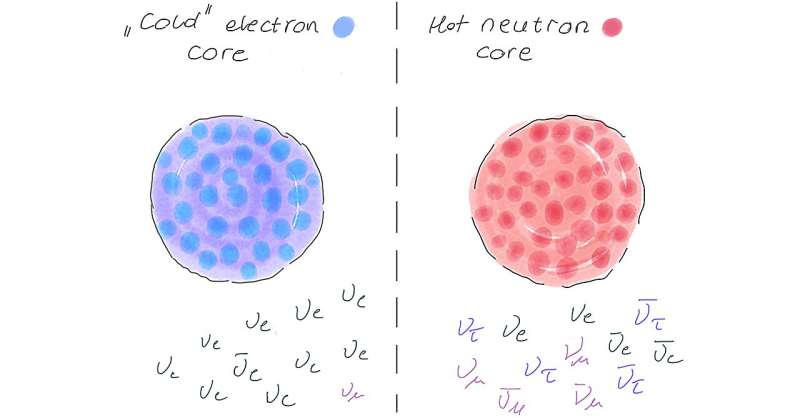
Research conducted by a team from the University of California – San Diego and the Network for Neutrinos, Nuclear Astrophysics, and Symmetries (N3AS) suggests that neutrinos, elementary particles known for their elusive nature, may interact in unexpected ways during the collapse of massive stars. The findings, published in Physical Review Letters on July 14, 2025, reveal that these interactions could significantly alter the fate of collapsing stars.
Neutrinos come in three distinct forms, known as flavors: electron, muon, and tau. Their fundamental properties remain largely enigmatic, particularly because laboratory conditions make it nearly impossible to observe their collisions directly. The research team, including lead authors Anna M. Suliga, Julien Froustey, Lukáš Gráf, Kyle Kehrer, and George Fuller, used theoretical calculations to demonstrate how collapsing stars can serve as a natural “neutrino collider.”
As massive stars undergo collapse, they experience extreme conditions that allow neutrinos to extract thermal energy from the stellar material. This process forces the stars to contract, driving their electrons to approach the speed of light. The instability that ensues can lead to a catastrophic collapse.
Potential Outcomes of Neutrino Interactions
The study indicates that as a star’s density increases during collapse, neutrinos may become trapped, resulting in collisions among themselves. Under standard model interactions, the neutrino flavor composition would predominantly be electron-flavored, leading to a relatively “cold” matter state and possibly leaving behind a neutron star remnant. In contrast, if secret interactions among neutrinos occur, the results are dramatically different.
Such interactions could create a diverse array of neutrino flavors and develop a “hot” core composed mainly of neutrons, which may ultimately result in the formation of a black hole remnant. The implications of these findings could reshape current understanding of stellar evolution and the end stages of massive stars.
Future experiments may provide further insights into these phenomena. The Fermi National Accelerator Lab is preparing for the Deep Underground Neutrino Experiment (DUNE), which aims to test these theories. Observations of neutrinos and gravitational waves from collapsing stars may also shed light on these interactions.
This research not only enhances the understanding of neutrinos but also opens doors to exploring fundamental questions in astrophysics. As scientists continue to unravel the mysteries of these elusive particles, the potential for groundbreaking discoveries remains high.






Belfast Gears Up for Vibrant St Patrick’s Day Parade on March 17

Cuba Faces Nationwide Blackout Amid Deepening Energy Crisis

Wirral Council to Restructure Leadership, Cutting Two Top Roles

Rethinking Resistance Training: Key Insights from US Experts

EU Membership on the Horizon: What It Means for Citizens

Ukrainian Drone Swarms Strike Moscow Region for Second Day

Henley Launches Innovative Initiative to Boost Local Economy

Court Ruling Allows Pandemic Tax Refund Claims Until 2026

Sean Penn’s Absence at 2026 Oscars Sparks Discussion

Coronation Street’s Shocking Murder Twist Reveals Family Secrets

Andrew Pierce Confirms Departure from ITV’s Good Morning Britain

Katie Price Faces New Health Concerns After Cancer Symptoms Resurface

Gyles Brandreth Shares Grandson’s Cancer Battle and Recovery

Sue Radford Reveals Weight Loss Journey, Shedding 12–13 kg

Kate Garraway Sells £2 Million Home Amid Financial Struggles

Jordan Brook Faces Health Crisis in Hospital as Sophie Kasaei Stays Away

EastEnders’ Nicola Mitchell Faces Unexpected Pregnancy Crisis

Reddit Study Reveals Distinctions Between Lurkers and Power Users
-
 World8 months ago
Coronation Street’s Shocking Murder Twist Reveals Family Secrets
-
 Entertainment8 months ago
Andrew Pierce Confirms Departure from ITV’s Good Morning Britain
-
 Health11 months ago
Katie Price Faces New Health Concerns After Cancer Symptoms Resurface
-
 Health6 months ago
Gyles Brandreth Shares Grandson’s Cancer Battle and Recovery
-
 Health6 months ago
Sue Radford Reveals Weight Loss Journey, Shedding 12–13 kg
-
 Entertainment1 year ago
Kate Garraway Sells £2 Million Home Amid Financial Struggles
-
 Entertainment5 months ago
Jordan Brook Faces Health Crisis in Hospital as Sophie Kasaei Stays Away
-
 World9 months ago
EastEnders’ Nicola Mitchell Faces Unexpected Pregnancy Crisis
-
 Science8 months ago
Reddit Study Reveals Distinctions Between Lurkers and Power Users
-

 World9 months ago
Mother Charged After Son, 9, Killed in Tragic Incident in Italy
-

 Entertainment11 months ago
Ann Ming Reflects on ITV’s ‘I Fought the Law’ Drama
-

 World9 months ago
Bailey Announces Heartbreaking Split from Rebecca After Reunion