
Science
Researchers Discover How Birds Use Feathers to Enhance Colors

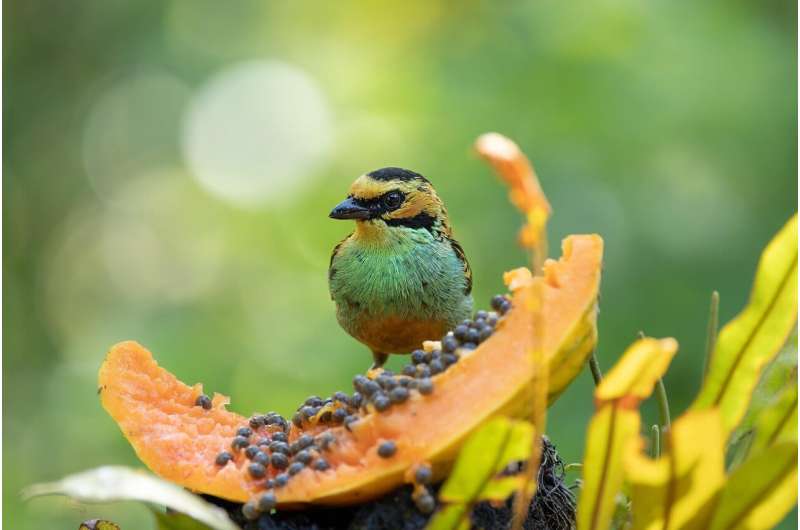
Birds, known for their vibrant plumage, exhibit an intriguing method for enhancing their colors using hidden black and white feathers. A team from Princeton University led by researcher Rosalyn Price-Waldman has published findings in Science Advances that reveal how these seemingly dull feathers play a crucial role in intensifying the brightness of blue and yellow plumage.
The study highlights a fascinating phenomenon in which colored feathers can appear more vivid when layered over a foundation of either black or white feathers. For instance, birds with blue feathers benefit significantly from a black under-layer, which absorbs light and allows the blue hue to stand out more prominently. This discovery emphasizes the role of sexual selection in avian coloration, a concept first introduced by Charles Darwin. Male birds often display brighter colors to attract mates, thus enhancing their reproductive success.
Mechanics of Color Enhancement
The mechanics behind this color enhancement are rooted in light absorption and reflection. When light passes through the blue feathers, the black layer underneath absorbs wavelengths that do not correspond to blue, allowing the color to “pop.” Conversely, yellow feathers, which derive their shade from carotenoid pigments, are enhanced by a white under-layer. This white foundation reflects light, increasing the brightness of the yellow and contrasting it sharply against other colors.
In their research, Price-Waldman and colleagues primarily focused on tanagers, colorful fruit-eating birds native to Central and South America. Upon discovering this coloration technique in tanagers, the researchers expanded their investigation to other bird families. Remarkably, they found that the use of black and white feathers to amplify color is common across various species, including the vibrant Australian fairy wrens.
Implications and Future Applications
The widespread application of this coloration strategy suggests that birds have been utilizing this method for tens of millions of years, showcasing an evolutionary advantage in their quest for attractive plumage. Understanding how such complex traits evolve in nature not only enhances our knowledge of avian biology but could also inspire advancements in fields such as architecture, art, and fashion, where vibrant colors are desirable.
The implications of this research extend beyond academic interest, encouraging further exploration into the evolutionary processes that shape animal coloration. As scientists continue to unravel the mysteries of bird plumage, the potential for new applications in human design becomes increasingly evident.
More information about this study can be found in the article titled “Hidden white and black feather layers enhance plumage coloration in tanagers and other songbirds,” available in Science Advances (2025), DOI: 10.1126/sciadv.adw5857.










Belfast Gears Up for Vibrant St Patrick’s Day Parade on March 17

Cuba Faces Nationwide Blackout Amid Deepening Energy Crisis

Wirral Council to Restructure Leadership, Cutting Two Top Roles

Rethinking Resistance Training: Key Insights from US Experts

EU Membership on the Horizon: What It Means for Citizens

Ukrainian Drone Swarms Strike Moscow Region for Second Day

Henley Launches Innovative Initiative to Boost Local Economy

Court Ruling Allows Pandemic Tax Refund Claims Until 2026

Sean Penn’s Absence at 2026 Oscars Sparks Discussion

Coronation Street’s Shocking Murder Twist Reveals Family Secrets

Andrew Pierce Confirms Departure from ITV’s Good Morning Britain

Katie Price Faces New Health Concerns After Cancer Symptoms Resurface

Gyles Brandreth Shares Grandson’s Cancer Battle and Recovery

Sue Radford Reveals Weight Loss Journey, Shedding 12–13 kg

Kate Garraway Sells £2 Million Home Amid Financial Struggles

Jordan Brook Faces Health Crisis in Hospital as Sophie Kasaei Stays Away

EastEnders’ Nicola Mitchell Faces Unexpected Pregnancy Crisis

Reddit Study Reveals Distinctions Between Lurkers and Power Users
-
 World8 months ago
Coronation Street’s Shocking Murder Twist Reveals Family Secrets
-
 Entertainment8 months ago
Andrew Pierce Confirms Departure from ITV’s Good Morning Britain
-
 Health11 months ago
Katie Price Faces New Health Concerns After Cancer Symptoms Resurface
-
 Health6 months ago
Gyles Brandreth Shares Grandson’s Cancer Battle and Recovery
-
 Health6 months ago
Sue Radford Reveals Weight Loss Journey, Shedding 12–13 kg
-
 Entertainment12 months ago
Kate Garraway Sells £2 Million Home Amid Financial Struggles
-
 Entertainment5 months ago
Jordan Brook Faces Health Crisis in Hospital as Sophie Kasaei Stays Away
-
 World9 months ago
EastEnders’ Nicola Mitchell Faces Unexpected Pregnancy Crisis
-
 Science8 months ago
Reddit Study Reveals Distinctions Between Lurkers and Power Users
-

 World9 months ago
Mother Charged After Son, 9, Killed in Tragic Incident in Italy
-

 Entertainment11 months ago
Ann Ming Reflects on ITV’s ‘I Fought the Law’ Drama
-

 World9 months ago
Bailey Announces Heartbreaking Split from Rebecca After Reunion