
Science
Astronomers Identify Potential ‘Superkilonova’ 1.3 Billion Light-Years Away

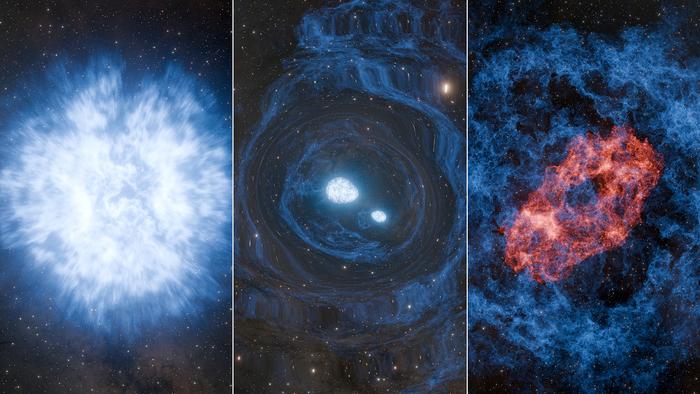
A team of astronomers led by Mansi Kasliwal from the California Institute of Technology (Caltech) has reported a groundbreaking discovery of a potential “superkilonova.” This unusual astronomical event was first detected by the Laser Interferometer Gravitational-wave Observatory (LIGO) and the Virgo gravitational wave detectors and subsequently observed by optical telescopes globally. The event, located approximately 1.3 billion light-years from Earth, may have resulted from the merger of two or more neutron stars, including at least one with a mass less than that of the Sun.
If confirmed, this would mark the first recorded observation of a superkilonova, a phenomenon theorized to occur when a kilonova transpires within a supernova. Such a discovery would significantly enhance our understanding of the life cycles of massive stars.
Understanding Supernovae and Kilonovae
A supernova is the explosive death of a massive star, which can occur when the star exhausts its nuclear fuel, leading to gravitational collapse. Alternatively, it can happen when a star accretes substantial matter from a nearby object. These cataclysmic events are crucial for generating heavy elements such as carbon and iron in the universe.
In contrast, kilonovae arise from the collision of two neutron stars, resulting in the production of even heavier elements, including gold and uranium. Both supernovae and kilonovae can be detected through the gravitational waves they emit and the light signals that reach Earth.
The first confirmed observation of a kilonova occurred in 2017 with the event known as GW170817. This merger of two neutron stars produced detectable gravitational waves and light signals, allowing astronomers to construct a comprehensive understanding of the phenomenon.
The recent event, initially designated ZTF 25abjmnps and later renamed AT2025ulz, suggests a different origin. According to Kasliwal and her team, this event could be a kilonova resulting from a supernova—a scenario that has not yet been observed, although theoretical models suggested its possibility.
Observation and Analysis of AT2025ulz
On August 18, 2025, gravitational waves from AT2025ulz were detected by LIGO facilities in Louisiana and Washington, as well as by Virgo in Italy. Astronomers quickly alerted their colleagues regarding this intriguing signal, which appeared to originate from a merger involving an unusually small object.
Shortly thereafter, the Zwicky Transient Facility (ZTF) at California’s Palomar Observatory identified a rapidly fading red object in the vicinity of the gravitational wave source, corroborating the detection. Additional observations from telescopes previously involved in the GROWTH program, such as the W M Keck Observatory in Hawaii and the Fraunhofer telescope at the Wendelstein Observatory in Germany, confirmed the rapid fading and red wavelengths of the light associated with AT2025ulz.
However, a few days later, the brightness of AT2025ulz increased, and its light spectra exhibited hydrogen lines, suggesting that it was a Type IIb supernova rather than a kilonova. Despite this, Kasliwal noted that AT2025ulz does not fit the typical profile of a supernova, leaving room for further investigation.
Kasliwal proposed two intriguing possibilities. The first involves a process where a rapidly spinning star undergoes a supernova explosion, forming a disc of material during its collapse. This disc could eventually form a neutron star, similar to how planets coalesce. The second scenario suggests that a rapidly spinning massive star could explode as a supernova and subsequently split into two neutron stars, both less massive than the Sun, which would then merge, creating a kilonova within the supernova—a phenomenon termed a superkilonova.
Kasliwal expressed excitement about the implications of this discovery, stating, “We have never seen any hints of anything like this before.” She emphasized the potential for nature to produce neutron stars that are less than solar mass and the possibility of multiple neutron stars forming within a stripped-envelope supernova.
To confirm the existence of a superkilonova, Kasliwal acknowledged the need for further observations, particularly through infrared spectroscopy from instruments like the James Webb Space Telescope (JWST) or the W M Keck Observatory. Unfortunately, the event is situated beyond the visibility range of the JWST, and the distance is too great for the Keck Observatory to gather infrared spectra. Nonetheless, Kasliwal noted the successful collection of “beautiful” optical spectra from Keck.
Looking ahead, Kasliwal and her team are determined to identify more events akin to AT2025ulz. “We will be keeping a close eye on any future events in which there are hints that the neutron star is sub-solar and look hard for a young stripped envelope supernova that could have exploded at the same time,” she stated.
With potential future discoveries of superkilonovae, astronomers could gain unprecedented insights into the life cycles of massive stars. The findings related to AT2025ulz are detailed in a recent publication in The Astrophysical Journal Letters.









Belfast Gears Up for Vibrant St Patrick’s Day Parade on March 17

Cuba Faces Nationwide Blackout Amid Deepening Energy Crisis

Wirral Council to Restructure Leadership, Cutting Two Top Roles

Rethinking Resistance Training: Key Insights from US Experts

EU Membership on the Horizon: What It Means for Citizens

Ukrainian Drone Swarms Strike Moscow Region for Second Day

Henley Launches Innovative Initiative to Boost Local Economy

Court Ruling Allows Pandemic Tax Refund Claims Until 2026

Sean Penn’s Absence at 2026 Oscars Sparks Discussion

Coronation Street’s Shocking Murder Twist Reveals Family Secrets

Andrew Pierce Confirms Departure from ITV’s Good Morning Britain

Katie Price Faces New Health Concerns After Cancer Symptoms Resurface

Sue Radford Reveals Weight Loss Journey, Shedding 12–13 kg

Kate Garraway Sells £2 Million Home Amid Financial Struggles

Jordan Brook Faces Health Crisis in Hospital as Sophie Kasaei Stays Away

EastEnders’ Nicola Mitchell Faces Unexpected Pregnancy Crisis

Bailey Announces Heartbreaking Split from Rebecca After Reunion

Ann Ming Reflects on ITV’s ‘I Fought the Law’ Drama
-
 World4 months ago
Coronation Street’s Shocking Murder Twist Reveals Family Secrets
-
 Entertainment4 months ago
Andrew Pierce Confirms Departure from ITV’s Good Morning Britain
-
 Health7 months ago
Katie Price Faces New Health Concerns After Cancer Symptoms Resurface
-
 Health2 months ago
Sue Radford Reveals Weight Loss Journey, Shedding 12–13 kg
-
 Entertainment8 months ago
Kate Garraway Sells £2 Million Home Amid Financial Struggles
-
 Entertainment3 weeks ago
Jordan Brook Faces Health Crisis in Hospital as Sophie Kasaei Stays Away
-
 World5 months ago
EastEnders’ Nicola Mitchell Faces Unexpected Pregnancy Crisis
-
 World5 months ago
Bailey Announces Heartbreaking Split from Rebecca After Reunion
-
 Entertainment7 months ago
Ann Ming Reflects on ITV’s ‘I Fought the Law’ Drama
-

 Entertainment2 months ago
Selena Gomez’s Name Linked to Epstein: Examining the Claims
-

 Health7 months ago
TOWIE Stars Sophie Kasaei and Jordan Brook Pursue Fertility Treatment
-

 Health7 months ago
Fiona Phillips’ Husband Shares Heartbreaking Update on Her Health