
Science
Astronomers Analyze 104 Quasars in Groundbreaking MIGHTEE Study

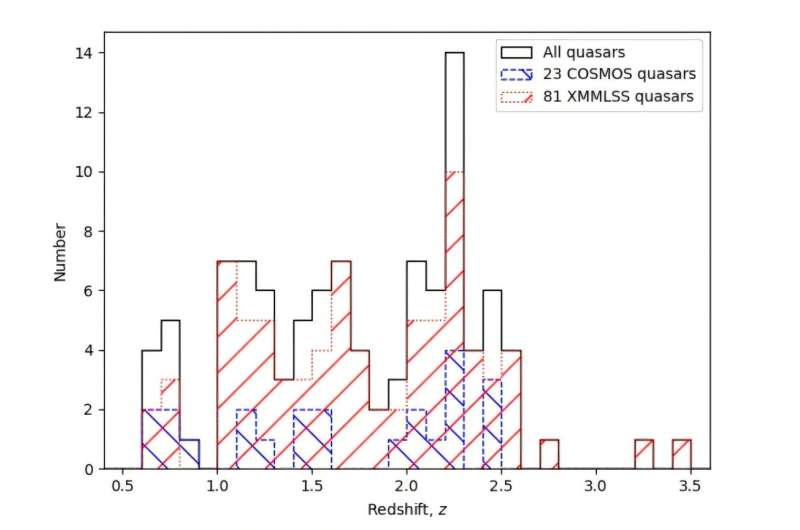
A team of astronomers from Rhodes University and collaborating institutions conducted an extensive analysis of 104 quasars identified through the MIGHTEE survey, utilizing data from the MeerKAT radio telescope in South Africa. This research, published on July 16, 2025, on the pre-print server arXiv, aims to deepen understanding of quasars and their various properties.
Quasars, or quasi-stellar objects, are among the universe’s most luminous and distant entities, playing a critical role in numerous astrophysical and cosmological studies. As active galactic nuclei (AGN), they emit electromagnetic radiation across a spectrum that includes radio, infrared, visible, ultraviolet, and X-ray wavelengths. The MIGHTEE survey, part of an ongoing effort to image the extragalactic sky, focuses on exploring the cosmic evolution of galaxies, including AGNs.
Insights into Quasar Characteristics
The research team, led by Sarah V. White, meticulously examined data from the COSMOS and XMM-LSS fields within the MIGHTEE survey. They focused on unobscured Type I quasars, which are characterized by broad emission lines. The selected quasars exhibited a range of redshifts between 0.6 and 3.41, with a median redshift of approximately 1.68.
The study’s findings revealed that the radio-loudness fraction for these quasars is estimated at 5%, aligning with previous observations from other quasar samples. Notably, the research indicated that the proportion of quasars with radio emissions dominated by AGN is lower than findings from other studies within the MIGHTEE sample. The astronomers hypothesized that this discrepancy may arise from the lower radio flux-density limit of the images, enhancing sensitivity to lower radio luminosities linked to star formation.
Moreover, the analysis highlighted a significant increase in the fraction of potential starburst galaxies among higher redshift quasars, jumping from 31-38% to 63% for sources at the highest redshifts. This trend suggests that identifying whether AGN dominate total radio emissions becomes increasingly complex as redshift increases.
Implications for Future Research
The authors of the study emphasize that the heightened incidence of starbursts in quasars at higher redshifts complicates the application of the “radio-excess” method for determining AGN dominance in radio emissions. They concluded by urging a reevaluation of methods for selecting and analyzing AGNs to account for these nuanced findings.
This research not only contributes to the understanding of quasar properties but also poses important considerations for future studies in astrophysics. The work was rigorously reviewed and fact-checked, reinforcing its credibility within the scientific community.
For more information, refer to the original study by Sarah V. White et al titled “MIGHTEE: A first look at MIGHTEE quasars,” available on arXiv.











Belfast Gears Up for Vibrant St Patrick’s Day Parade on March 17

Cuba Faces Nationwide Blackout Amid Deepening Energy Crisis

Wirral Council to Restructure Leadership, Cutting Two Top Roles

Rethinking Resistance Training: Key Insights from US Experts

EU Membership on the Horizon: What It Means for Citizens

Ukrainian Drone Swarms Strike Moscow Region for Second Day

Henley Launches Innovative Initiative to Boost Local Economy

Court Ruling Allows Pandemic Tax Refund Claims Until 2026

Sean Penn’s Absence at 2026 Oscars Sparks Discussion

Coronation Street’s Shocking Murder Twist Reveals Family Secrets

Andrew Pierce Confirms Departure from ITV’s Good Morning Britain

Katie Price Faces New Health Concerns After Cancer Symptoms Resurface

Gyles Brandreth Shares Grandson’s Cancer Battle and Recovery

Sue Radford Reveals Weight Loss Journey, Shedding 12–13 kg

Kate Garraway Sells £2 Million Home Amid Financial Struggles

Jordan Brook Faces Health Crisis in Hospital as Sophie Kasaei Stays Away

EastEnders’ Nicola Mitchell Faces Unexpected Pregnancy Crisis

Reddit Study Reveals Distinctions Between Lurkers and Power Users
-
 World8 months ago
Coronation Street’s Shocking Murder Twist Reveals Family Secrets
-
 Entertainment8 months ago
Andrew Pierce Confirms Departure from ITV’s Good Morning Britain
-
 Health12 months ago
Katie Price Faces New Health Concerns After Cancer Symptoms Resurface
-
 Health7 months ago
Gyles Brandreth Shares Grandson’s Cancer Battle and Recovery
-
 Health7 months ago
Sue Radford Reveals Weight Loss Journey, Shedding 12–13 kg
-
 Entertainment1 year ago
Kate Garraway Sells £2 Million Home Amid Financial Struggles
-
 Entertainment5 months ago
Jordan Brook Faces Health Crisis in Hospital as Sophie Kasaei Stays Away
-
 World10 months ago
EastEnders’ Nicola Mitchell Faces Unexpected Pregnancy Crisis
-
 Science8 months ago
Reddit Study Reveals Distinctions Between Lurkers and Power Users
-

 World9 months ago
Mother Charged After Son, 9, Killed in Tragic Incident in Italy
-

 Entertainment12 months ago
Ann Ming Reflects on ITV’s ‘I Fought the Law’ Drama
-

 World9 months ago
Bailey Announces Heartbreaking Split from Rebecca After Reunion