
Science
Interstellar Comet 3I/ATLAS Departs, Unveils Mystifying Anti-Tail

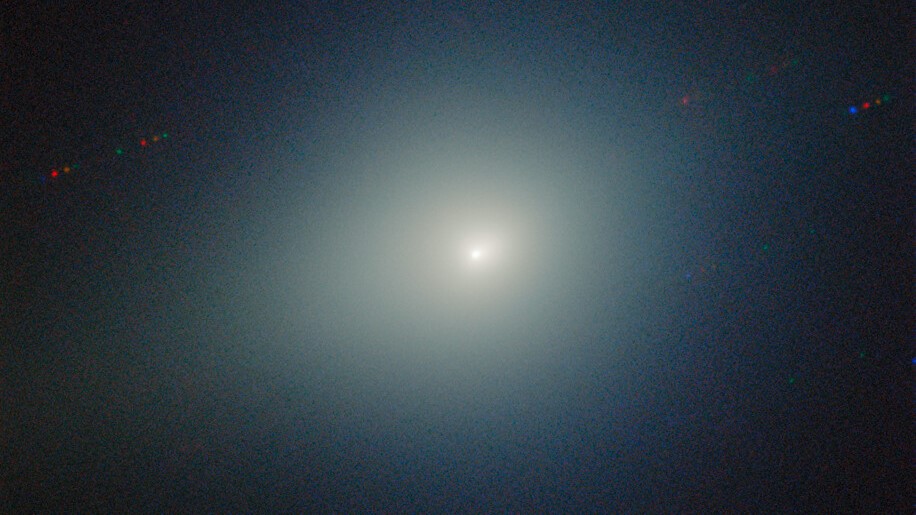
Interstellar comet 3I/ATLAS is now departing from the solar system, yet its unusual anti-tail continues to intrigue scientists. This comet, only the third known interstellar object, has exhibited unexpected behaviours that challenge existing understandings of cosmic phenomena. As 3I/ATLAS moves further from Earth’s view, astronomers are meticulously studying its features, particularly the anti-tail that has shown a rhythmic wobble.
The comet’s anti-tail presents a unique structure that points towards the Sun, contrasting with typical comet tails that stream away due to solar radiation. Observations indicate that this anti-tail may stretch up to 620,000 miles (approximately 1 million km). Researchers have noted jet-like outflows of dust and gas within this structure, which oscillate in a distinct pattern every 7 hours and 45 minutes. This behaviour suggests that the comet’s nucleus, its solid and icy core, is rotating in a manner that influences the release of material into space.
Utilizing the Two-metre Twin Telescope at the Teide Observatory in Tenerife, scientists have tracked the shifting jets in the anti-tail over several nights. The observed periodicity hints at a rotation period for the nucleus of approximately 15 hours and 30 minutes. This information is crucial as it provides insights into the comet’s internal composition and may reflect the conditions prevalent in the region of the galaxy where it originated.
3I/ATLAS was first detected in June 2025 and reached its closest point to Earth on December 19, 2025, at a distance of about 270 million km (or 168 million miles). The comet’s rare anti-tail and jet behaviours present a significant opportunity for researchers to validate existing models of comet physics. While anti-tails and jet activity have been observed in comets within our solar system, this marks the first instance of such behaviours being documented in an interstellar visitor.
The discovery of the wobbling jets and the unusual anti-tail poses new questions for scientists. Are these patterns indicative of structural or compositional differences compared to typical comets? What can this tell us about the formation of bodies around other stars? The insights gained from observing 3I/ATLAS may provide valuable data about processes that could be common across the galaxy.
As 3I/ATLAS fades into the vastness of space, its contributions to science will endure. Researchers continue to analyse the data collected, and the findings from this interstellar visitor could lead to a deeper understanding of the complex physics that govern celestial bodies. The legacy of 3I/ATLAS may well shape the future of astronomical research and our comprehension of the cosmos.








Belfast Gears Up for Vibrant St Patrick’s Day Parade on March 17

Cuba Faces Nationwide Blackout Amid Deepening Energy Crisis

Wirral Council to Restructure Leadership, Cutting Two Top Roles

Rethinking Resistance Training: Key Insights from US Experts

EU Membership on the Horizon: What It Means for Citizens

Ukrainian Drone Swarms Strike Moscow Region for Second Day

Henley Launches Innovative Initiative to Boost Local Economy

Court Ruling Allows Pandemic Tax Refund Claims Until 2026

Sean Penn’s Absence at 2026 Oscars Sparks Discussion

Coronation Street’s Shocking Murder Twist Reveals Family Secrets

Andrew Pierce Confirms Departure from ITV’s Good Morning Britain

Katie Price Faces New Health Concerns After Cancer Symptoms Resurface

Gyles Brandreth Shares Grandson’s Cancer Battle and Recovery

Sue Radford Reveals Weight Loss Journey, Shedding 12–13 kg

Kate Garraway Sells £2 Million Home Amid Financial Struggles

Jordan Brook Faces Health Crisis in Hospital as Sophie Kasaei Stays Away

EastEnders’ Nicola Mitchell Faces Unexpected Pregnancy Crisis

Reddit Study Reveals Distinctions Between Lurkers and Power Users
-
 World9 months ago
Coronation Street’s Shocking Murder Twist Reveals Family Secrets
-
 Entertainment9 months ago
Andrew Pierce Confirms Departure from ITV’s Good Morning Britain
-
 Health12 months ago
Katie Price Faces New Health Concerns After Cancer Symptoms Resurface
-
 Health7 months ago
Gyles Brandreth Shares Grandson’s Cancer Battle and Recovery
-
 Health7 months ago
Sue Radford Reveals Weight Loss Journey, Shedding 12–13 kg
-
 Entertainment1 year ago
Kate Garraway Sells £2 Million Home Amid Financial Struggles
-
 Entertainment5 months ago
Jordan Brook Faces Health Crisis in Hospital as Sophie Kasaei Stays Away
-
 World10 months ago
EastEnders’ Nicola Mitchell Faces Unexpected Pregnancy Crisis
-
 Science9 months ago
Reddit Study Reveals Distinctions Between Lurkers and Power Users
-

 World9 months ago
Mother Charged After Son, 9, Killed in Tragic Incident in Italy
-

 Entertainment12 months ago
Ann Ming Reflects on ITV’s ‘I Fought the Law’ Drama
-

 Entertainment7 months ago
Selena Gomez’s Name Linked to Epstein: Examining the Claims