
Top Stories
NASA Unveils Stunning Hubble Images of Comet 3I/ATLAS

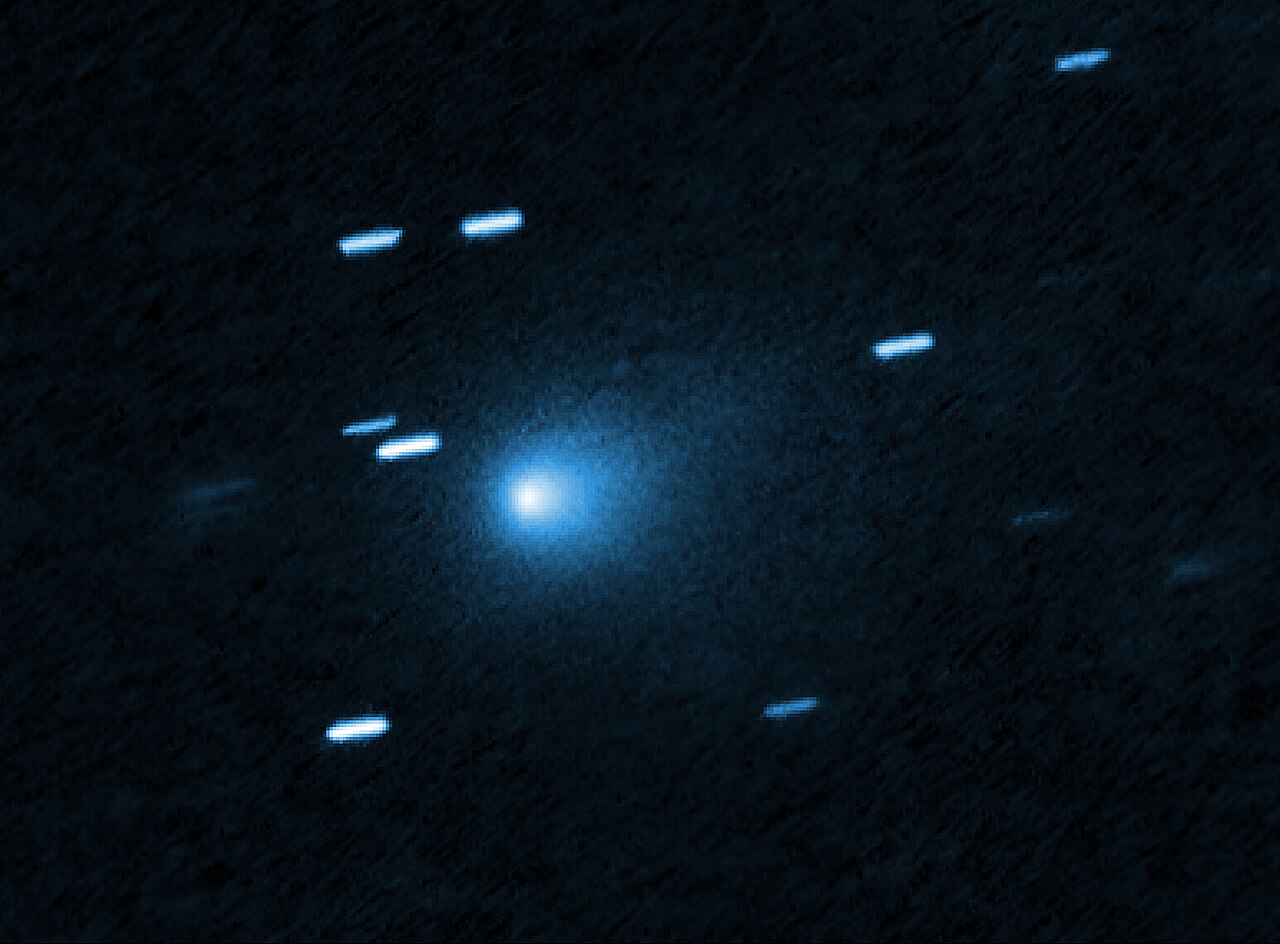
NASA has released new images of the interstellar comet 3I/ATLAS, offering the first detailed view of the object following its close encounter with the Sun in late October. Captured by the Hubble Space Telescope on November 30, 2023, these images confirm that the comet remains active as it moves away from the Sun and back into deep space. Astronomers are gearing up for a series of viewing opportunities in mid-December, allowing ground observers to see the comet through telescopes.
Currently, 3I/ATLAS is located hundreds of millions of kilometres from Earth and is not visible to the naked eye. However, it will make its closest approach to Earth on December 19, 2023, providing a prime opportunity for amateur astronomers equipped with telescopes to observe the comet more closely.
Insights from Hubble and ESA
The new Hubble images show 3I/ATLAS emitting trails of gas and dust. The stars behind the comet appear elongated, a result of the telescope tracking the object’s rapid motion during the imaging process. The European Space Agency (ESA) has also contributed to the observations, releasing images captured by the Jupiter Icy Moons Explorer (JUICE) on November 2, 2023. These images reveal the glowing halo of gas surrounding the comet, known as its coma, and hint at two distinct tails: a “plasma tail” made up of electrically charged gas and a fainter “dust tail” of solid particles.
An ESA spokesperson noted, “Not only do we clearly see the glowing halo of gas surrounding the comet known as its coma, we also see a hint of two tails.” The observations made by both NASA and ESA provide crucial data about the comet’s composition and behavior as it travels through the solar system.
Chemical Analysis and Implications
Recent studies have revealed that 3I/ATLAS produces significant amounts of methanol as it approaches the Sun. The Atacama Large Millimetre/Submillimetre Array (ALMA) detected measurable production of methanol and hydrogen cyanide during several observations this year, specifically on August 28, September 18, September 22, and October 1. The presence of these chemicals is significant, as the ratio of methanol to hydrogen cyanide offers valuable insights into the comet’s origin.
Harvard physicist Avi Loeb highlighted that 3I/ATLAS has one of the highest methanol-to-hydrogen cyanide ratios ever recorded, second only to C/2016 R2. Methanol is considered a key ingredient in the formation of complex organic molecules, essential for life. A high ratio of methanol suggests that this comet may have originated in a cold, carbon-rich environment, differing from the conditions that typically yield comets in our Solar System.
This unique chemical signature allows astronomers to study the conditions of a protoplanetary disk from another star system. By analysing the outgassing of 3I/ATLAS, scientists can conduct a form of remote geology, gaining insights into planetary system formation. This research could significantly enhance our understanding of how celestial bodies evolve in different environments.
As 3I/ATLAS continues its journey, both amateur and professional astronomers are keenly awaiting the upcoming viewing window. The opportunity to observe this active interstellar visitor not only excites the scientific community but also the public, who will have a chance to witness a rare cosmic event.







Belfast Gears Up for Vibrant St Patrick’s Day Parade on March 17

Cuba Faces Nationwide Blackout Amid Deepening Energy Crisis

Wirral Council to Restructure Leadership, Cutting Two Top Roles

Rethinking Resistance Training: Key Insights from US Experts

EU Membership on the Horizon: What It Means for Citizens

Ukrainian Drone Swarms Strike Moscow Region for Second Day

Henley Launches Innovative Initiative to Boost Local Economy

Court Ruling Allows Pandemic Tax Refund Claims Until 2026

Sean Penn’s Absence at 2026 Oscars Sparks Discussion

Coronation Street’s Shocking Murder Twist Reveals Family Secrets

Andrew Pierce Confirms Departure from ITV’s Good Morning Britain

Katie Price Faces New Health Concerns After Cancer Symptoms Resurface

Gyles Brandreth Shares Grandson’s Cancer Battle and Recovery

Sue Radford Reveals Weight Loss Journey, Shedding 12–13 kg

Kate Garraway Sells £2 Million Home Amid Financial Struggles

Jordan Brook Faces Health Crisis in Hospital as Sophie Kasaei Stays Away

EastEnders’ Nicola Mitchell Faces Unexpected Pregnancy Crisis

Mother Charged After Son, 9, Killed in Tragic Incident in Italy
-
 World7 months ago
Coronation Street’s Shocking Murder Twist Reveals Family Secrets
-
 Entertainment7 months ago
Andrew Pierce Confirms Departure from ITV’s Good Morning Britain
-
 Health10 months ago
Katie Price Faces New Health Concerns After Cancer Symptoms Resurface
-
 Health5 months ago
Gyles Brandreth Shares Grandson’s Cancer Battle and Recovery
-
 Health6 months ago
Sue Radford Reveals Weight Loss Journey, Shedding 12–13 kg
-
 Entertainment11 months ago
Kate Garraway Sells £2 Million Home Amid Financial Struggles
-
 Entertainment4 months ago
Jordan Brook Faces Health Crisis in Hospital as Sophie Kasaei Stays Away
-
 World8 months ago
EastEnders’ Nicola Mitchell Faces Unexpected Pregnancy Crisis
-
 World8 months ago
Mother Charged After Son, 9, Killed in Tragic Incident in Italy
-

 Entertainment10 months ago
Ann Ming Reflects on ITV’s ‘I Fought the Law’ Drama
-

 World8 months ago
Bailey Announces Heartbreaking Split from Rebecca After Reunion
-

 Entertainment5 months ago
Selena Gomez’s Name Linked to Epstein: Examining the Claims