
Science
Scientists Achieve Breakthrough in Single-Photon Teleportation

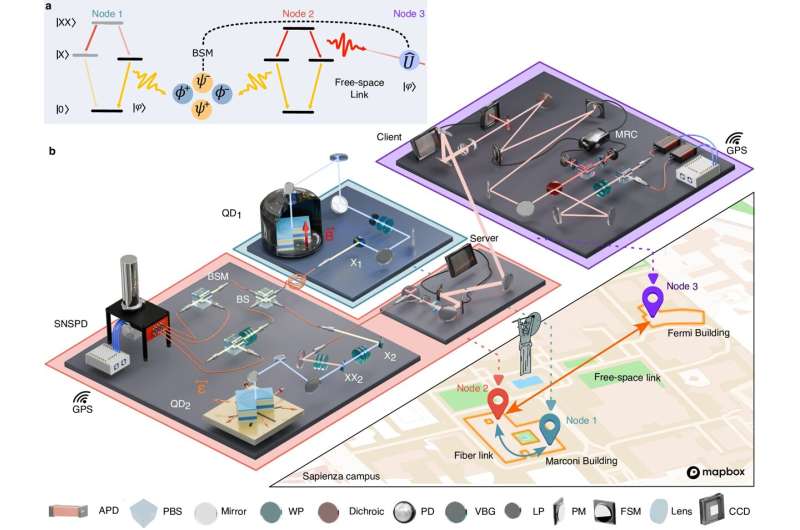
An international research team led by Paderborn University has successfully accomplished a significant milestone in quantum communication. For the first time, the polarization state of a single photon emitted from one quantum dot was teleported to another quantum dot located a distance away. This breakthrough represents a vital step toward realizing a quantum internet, where information can be transmitted securely and efficiently.
The experiments utilized a 270-meter free-space optical link, allowing researchers to establish teleportation between two physically separated quantum dots. The findings have been published in the journal Nature Communications.
Collaboration Fuels Advancements
The project involved a long-term collaboration among doctoral and postdoctoral students at Paderborn University, who have dedicated nearly a decade to optical measurements and data analysis. Professor Klaus Jöns, head of the Hybrid Photonics Quantum Devices research group at Paderborn University, emphasized the importance of the experiment. “This demonstrates that quantum light sources based on semiconductor quantum dots could serve as a key technology for future quantum communication networks,” he stated.
The research team worked closely with Professor Rinaldo Trotta from the Sapienza University of Rome. Jöns noted that successful quantum teleportation between independent quantum emitters is essential for developing scalable quantum relays, which are critical for implementing a practical quantum internet.
Entangled systems comprising multiple quantum particles provide significant advantages for quantum communication. Rather than relying on a single state from one photon, these systems utilize a multitude of states, enhancing capabilities in communication, data security, and quantum computing. “Previously, these photons came from the same source,” Jöns explained. “Using distinct quantum emitters to implement a quantum relay between independent parties had remained out of reach until now.”
A Decade of Strategic Planning
The groundwork for this success was laid over ten years ago when Jöns and Trotta devised a roadmap for utilizing quantum dots as sources of entangled photon pairs for quantum communication and teleportation protocols. “This result shows that our long-term strategic planning has paid off,” Jöns remarked, attributing the achievement to a combination of exceptional materials science, nanofabrication, and optical quantum technology.
The successful teleportation was made possible through a Europe-wide collaboration. Quantum dots were developed at Johannes Kepler University Linz, while the resonators were fabricated by partners at the University of Würzburg. The quantum teleportation experiments were carried out at Sapienza University, which included the use of a 270-meter free-space optical link connecting two university buildings. The experimental protocol employed GPS-assisted synchronization, ultra-fast single photon detectors, and stabilization systems to counteract atmospheric turbulence.
The fidelity of the achieved teleportation state, indicating the preservation quality of quantum states during teleportation, reached up to 82 ± 1%, surpassing classical limits by more than 10 standard deviations.
Looking ahead, the research team aims to demonstrate “entanglement swapping” between two quantum dots, which would represent the first quantum relay utilizing two deterministic sources of entangled photon pairs. Deterministic quantum sources can produce single photons reliably and efficiently, a feat that has posed significant challenges until now.
In a parallel effort, a research team from Stuttgart and Saarbrücken achieved similar results using frequency conversion, marking a significant milestone for European quantum research. Together, these projects underscore the momentum building in the field of quantum communication.
For further details, refer to the study by Alessandro Laneve et al., titled “Quantum teleportation with dissimilar quantum dots over a hybrid quantum network,” published in Nature Communications on December 2, 2025.










Belfast Gears Up for Vibrant St Patrick’s Day Parade on March 17

Cuba Faces Nationwide Blackout Amid Deepening Energy Crisis

Wirral Council to Restructure Leadership, Cutting Two Top Roles

Rethinking Resistance Training: Key Insights from US Experts

EU Membership on the Horizon: What It Means for Citizens

Ukrainian Drone Swarms Strike Moscow Region for Second Day

Henley Launches Innovative Initiative to Boost Local Economy

Court Ruling Allows Pandemic Tax Refund Claims Until 2026

Sean Penn’s Absence at 2026 Oscars Sparks Discussion

Coronation Street’s Shocking Murder Twist Reveals Family Secrets

Andrew Pierce Confirms Departure from ITV’s Good Morning Britain

Katie Price Faces New Health Concerns After Cancer Symptoms Resurface

Gyles Brandreth Shares Grandson’s Cancer Battle and Recovery

Sue Radford Reveals Weight Loss Journey, Shedding 12–13 kg

Kate Garraway Sells £2 Million Home Amid Financial Struggles

Jordan Brook Faces Health Crisis in Hospital as Sophie Kasaei Stays Away

EastEnders’ Nicola Mitchell Faces Unexpected Pregnancy Crisis

Mother Charged After Son, 9, Killed in Tragic Incident in Italy
-
 World7 months ago
Coronation Street’s Shocking Murder Twist Reveals Family Secrets
-
 Entertainment7 months ago
Andrew Pierce Confirms Departure from ITV’s Good Morning Britain
-
 Health10 months ago
Katie Price Faces New Health Concerns After Cancer Symptoms Resurface
-
 Health5 months ago
Gyles Brandreth Shares Grandson’s Cancer Battle and Recovery
-
 Health6 months ago
Sue Radford Reveals Weight Loss Journey, Shedding 12–13 kg
-
 Entertainment11 months ago
Kate Garraway Sells £2 Million Home Amid Financial Struggles
-
 Entertainment4 months ago
Jordan Brook Faces Health Crisis in Hospital as Sophie Kasaei Stays Away
-
 World8 months ago
EastEnders’ Nicola Mitchell Faces Unexpected Pregnancy Crisis
-
 World8 months ago
Mother Charged After Son, 9, Killed in Tragic Incident in Italy
-

 Entertainment10 months ago
Ann Ming Reflects on ITV’s ‘I Fought the Law’ Drama
-

 World8 months ago
Bailey Announces Heartbreaking Split from Rebecca After Reunion
-

 Entertainment5 months ago
Selena Gomez’s Name Linked to Epstein: Examining the Claims