
Science
Researchers Pioneer Individualized Radiotherapy Using Dual-Tracer PET

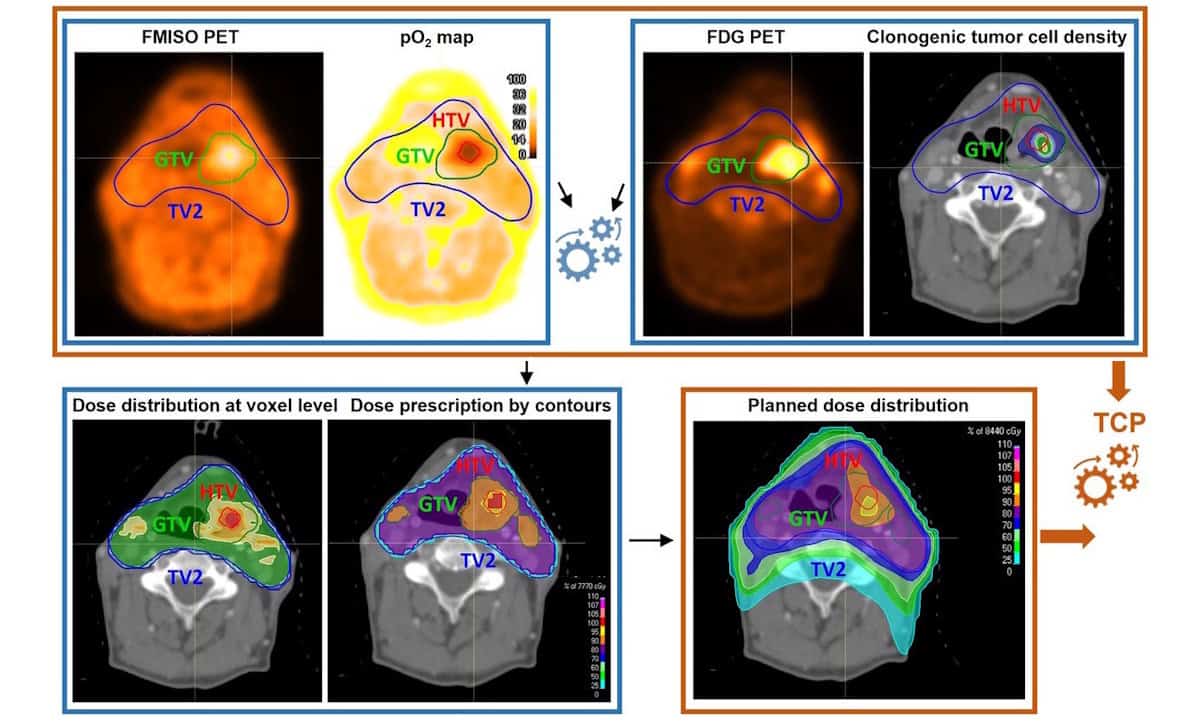
Radiation therapy traditionally uses a uniform dose for specific tumor types, often leading to inadequate treatment due to the unique characteristics of individual tumors. Researchers from Sweden and Germany have initiated a study investigating whether biologically individualized radiotherapy, guided by dual-tracer PET imaging, can enhance treatment effectiveness for patients with advanced head-and-neck squamous cell carcinoma (HNSCC).
The research team, led by Marta Lazzeroni from Stockholm University, assessed 28 patients who underwent two pre-treatment PET/CT scans. These scans utilized two different tracers: 18 F-fluoromisonidazole (FMISO) to measure radioresistance and 18 F-FDG to evaluate tumor cellularity. This dual approach addresses the inherent radiosensitivity and heterogeneity of tumors, factors that significantly impact treatment outcomes.
Lazzeroni explained that “FMISO provides information on hypoxia-related radioresistance, but tumor control also strongly depends on the number of clonogenic cells, which is not captured by hypoxia imaging alone.” The study marks a pioneering effort to integrate both FMISO and FDG PET data within a unified framework to enhance dose escalation tailored to individual tumor profiles.
Innovative Treatment Planning and Results
Using the data from the PET scans, the researchers created voxel-level maps to assess oxygen partial pressure (pO2) in the tumors, subsequently defining a hypoxic target volume (HTV). The FDG scans provided insight into the distribution of clonogenic tumor cell density, which directly influences the necessary dose to achieve a specific tumor control probability (TCP).
The automated planning system generated volumetric-modulated arc therapy plans that included 35 treatment fractions with an integrated boost for radioresistant subvolumes, while ensuring safe sparing of critical organs. Each treatment plan achieved an average biologically equivalent dose of 81±3.2 Gy to the HTV, successfully adhering to clinical safety standards for protecting the brainstem, spinal cord, and mandible. Notably, parotid glands were spared in 75% of cases.
The results indicate a significant advancement in the field, suggesting that the personalized dose-escalation strategy is clinically feasible and could be integrated into current treatment protocols. The research team also conducted a radiobiological evaluation, calculating TCP based on the planned dose distribution and PET-derived data. The findings revealed TCP values exceeding 90% for all patients, a substantial improvement compared to the typical 60% tumor control rates documented in existing clinical literature for HNSCC.
Future Directions and Clinical Implications
While these promising results stem from pre-treatment PET images, the researchers acknowledge that biological changes during the course of treatment, particularly fluctuations in tumor hypoxia, may influence the effectiveness of their approach. They propose that future studies could benefit from longitudinal imaging, including PET/CT scans at intervals during treatment, to monitor the evolving tumor biology. This would enable adaptive replanning to ensure optimal tumor control while minimizing damage to healthy tissue.
Lazzeroni emphasizes the need for further validation, stating, “This study was designed as a feasibility and modeling investigation, and the next step is prospective clinical validation.” The group led by Anca-L Grosu in Germany is currently planning prospective clinical trials. These trials aim to integrate ongoing PET imaging into treatment protocols to facilitate biologically adaptive radiotherapy, optimizing outcomes for patients with HNSCC.
The findings of this study have been published in the Journal of Nuclear Medicine, marking a significant step forward in the quest for more personalized and effective cancer treatments.











Belfast Gears Up for Vibrant St Patrick’s Day Parade on March 17

Cuba Faces Nationwide Blackout Amid Deepening Energy Crisis

Wirral Council to Restructure Leadership, Cutting Two Top Roles

Rethinking Resistance Training: Key Insights from US Experts

EU Membership on the Horizon: What It Means for Citizens

Ukrainian Drone Swarms Strike Moscow Region for Second Day

Henley Launches Innovative Initiative to Boost Local Economy

Court Ruling Allows Pandemic Tax Refund Claims Until 2026

Sean Penn’s Absence at 2026 Oscars Sparks Discussion

Coronation Street’s Shocking Murder Twist Reveals Family Secrets

Andrew Pierce Confirms Departure from ITV’s Good Morning Britain

Katie Price Faces New Health Concerns After Cancer Symptoms Resurface

Gyles Brandreth Shares Grandson’s Cancer Battle and Recovery

Sue Radford Reveals Weight Loss Journey, Shedding 12–13 kg

Kate Garraway Sells £2 Million Home Amid Financial Struggles

Jordan Brook Faces Health Crisis in Hospital as Sophie Kasaei Stays Away

EastEnders’ Nicola Mitchell Faces Unexpected Pregnancy Crisis

Mother Charged After Son, 9, Killed in Tragic Incident in Italy
-
 World7 months ago
Coronation Street’s Shocking Murder Twist Reveals Family Secrets
-
 Entertainment7 months ago
Andrew Pierce Confirms Departure from ITV’s Good Morning Britain
-
 Health10 months ago
Katie Price Faces New Health Concerns After Cancer Symptoms Resurface
-
 Health5 months ago
Gyles Brandreth Shares Grandson’s Cancer Battle and Recovery
-
 Health5 months ago
Sue Radford Reveals Weight Loss Journey, Shedding 12–13 kg
-
 Entertainment11 months ago
Kate Garraway Sells £2 Million Home Amid Financial Struggles
-
 Entertainment4 months ago
Jordan Brook Faces Health Crisis in Hospital as Sophie Kasaei Stays Away
-
 World8 months ago
EastEnders’ Nicola Mitchell Faces Unexpected Pregnancy Crisis
-
 World8 months ago
Mother Charged After Son, 9, Killed in Tragic Incident in Italy
-

 Entertainment10 months ago
Ann Ming Reflects on ITV’s ‘I Fought the Law’ Drama
-

 World8 months ago
Bailey Announces Heartbreaking Split from Rebecca After Reunion
-

 Entertainment5 months ago
Selena Gomez’s Name Linked to Epstein: Examining the Claims