
Health
New US Dietary Guidelines Spark Debate Over Health Recommendations

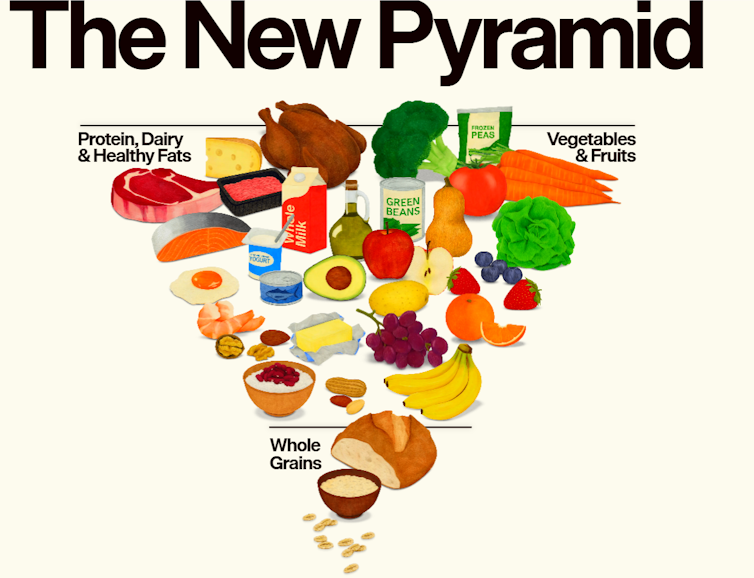
The recently released Dietary Guidelines for Americans (DGAs) for 2025-2030 have ignited considerable controversy due to their radical departure from established public health recommendations. For the first time since 1980, the standard scientific procedures that have traditionally guided the development of these guidelines have been bypassed, leading to polarized opinions among health experts and the public alike.
A key feature of the new guidelines is their graphic representation, which shifts from the familiar MyPlate and food pyramid models to an inverted pyramid. This design visually ranks food groups, placing the most recommended items at the top and the least recommended at the bottom. While the inverted pyramid format is not entirely novel—previously employed by the Flemish Institute for Healthy Living in 2017—this new approach has drawn scrutiny for its lack of clarity and transparency.
The content of the 2025-2030 DGAs raises further questions. The guidelines suggest that saturated fats should not exceed 10% of total calorie intake, yet they advocate for regular consumption of beef, butter, and whole milk products. This apparent contradiction undermines the integrity of the recommendations. Additionally, while whole grains are positioned at the bottom of the pyramid, they share the same recommended servings per day—between 2 and 4—as the more prominently recommended foods. Notably, legumes, a crucial component of a balanced diet, are entirely absent from the graphic.
The process for updating the DGAs has historically involved thorough review and public consultation led by the USDA and the Department of Health and Human Services (HHS). Over two years, an independent panel known as the Dietary Guidelines Advisory Committee assesses evidence and prepares a comprehensive report. However, the current edition diverged significantly from this norm. After receiving the Advisory Committee’s 421-page report, the Trump administration initiated an expedited review process lasting less than six months. An alternative panel, the Scientific Foundation for the Dietary Guidelines for Americans, produced a 90-page report that lacked the usual transparency and public engagement associated with such documents.
The new report starkly illustrates its approach with a checklist detailing the treatment of the Advisory Committee’s 56 recommendations. Out of these, only 14 were fully accepted, 12 were partially accepted, and a significant 30 were outright rejected. This shift signals a distinct change in the administration’s stance on dietary advice, as highlighted by Spanish author Mauro Entrialgo’s term “malismo,” which refers to the deliberate use of questionable ideas to attract public support.
Compounding concerns about the new guidelines is the potential influence of industry ties among some authors of the alternative report, particularly those connected to the dairy and cattle sectors. This raises questions about the integrity of the recommendations, especially given the financial interests at stake.
The rationale presented for the current guidelines posits that the health crisis among Americans stems from decades of federal recommendations. This reasoning reflects a classic post hoc reasoning fallacy, suggesting that the previous DGAs are solely responsible for the rise in obesity and chronic diseases. In reality, prior editions of the DGAs did not endorse ultra-processed foods, and adherence to these guidelines has historically been low among the public.
In summary, the 2025-2030 Dietary Guidelines for Americans present a mix of scientifically questionable recommendations, contradictions, and ideologically motivated content. As the public health community grapples with these changes, the potential impact on nutrition and health outcomes remains a critical concern. The guidelines, described by some as a blend of healthy ingredients and corporate influences, reflect a significant departure from previous approaches to dietary advice.

Belfast Gears Up for Vibrant St Patrick’s Day Parade on March 17

Cuba Faces Nationwide Blackout Amid Deepening Energy Crisis

Wirral Council to Restructure Leadership, Cutting Two Top Roles

Rethinking Resistance Training: Key Insights from US Experts

EU Membership on the Horizon: What It Means for Citizens

Ukrainian Drone Swarms Strike Moscow Region for Second Day

Henley Launches Innovative Initiative to Boost Local Economy

Court Ruling Allows Pandemic Tax Refund Claims Until 2026

Sean Penn’s Absence at 2026 Oscars Sparks Discussion

Coronation Street’s Shocking Murder Twist Reveals Family Secrets

Andrew Pierce Confirms Departure from ITV’s Good Morning Britain

Katie Price Faces New Health Concerns After Cancer Symptoms Resurface

Sue Radford Reveals Weight Loss Journey, Shedding 12–13 kg

Kate Garraway Sells £2 Million Home Amid Financial Struggles

Jordan Brook Faces Health Crisis in Hospital as Sophie Kasaei Stays Away

EastEnders’ Nicola Mitchell Faces Unexpected Pregnancy Crisis

Bailey Announces Heartbreaking Split from Rebecca After Reunion

Ann Ming Reflects on ITV’s ‘I Fought the Law’ Drama
-
 World4 months ago
Coronation Street’s Shocking Murder Twist Reveals Family Secrets
-
 Entertainment4 months ago
Andrew Pierce Confirms Departure from ITV’s Good Morning Britain
-
 Health7 months ago
Katie Price Faces New Health Concerns After Cancer Symptoms Resurface
-
 Health3 months ago
Sue Radford Reveals Weight Loss Journey, Shedding 12–13 kg
-
 Entertainment8 months ago
Kate Garraway Sells £2 Million Home Amid Financial Struggles
-
 Entertainment4 weeks ago
Jordan Brook Faces Health Crisis in Hospital as Sophie Kasaei Stays Away
-
 World5 months ago
EastEnders’ Nicola Mitchell Faces Unexpected Pregnancy Crisis
-
 World5 months ago
Bailey Announces Heartbreaking Split from Rebecca After Reunion
-
 Entertainment7 months ago
Ann Ming Reflects on ITV’s ‘I Fought the Law’ Drama
-

 Entertainment2 months ago
Selena Gomez’s Name Linked to Epstein: Examining the Claims
-

 Health7 months ago
TOWIE Stars Sophie Kasaei and Jordan Brook Pursue Fertility Treatment
-

 Health8 months ago
Fiona Phillips’ Husband Shares Heartbreaking Update on Her Health