
Science
Physicists Unlock Structure of Radium Monofluoride Using Electrons

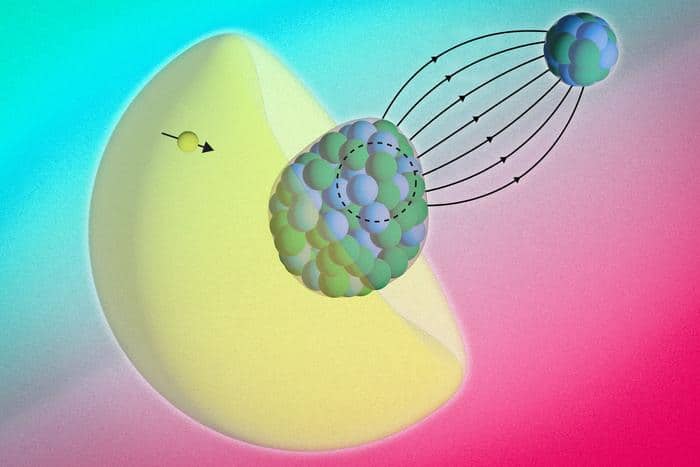
Physicists have achieved a significant breakthrough by obtaining the first detailed image of the internal structure of radium monofluoride (RaF). The study, which includes contributions from researchers at the Massachusetts Institute of Technology (MIT) and other institutions, utilized the molecule’s own electrons to penetrate its nucleus and interact with its protons and neutrons. This phenomenon, known as the Bohr-Weisskopf effect, has now been observed in a molecule for the first time.
Shane Wilkins, co-leader of the study, emphasized the importance of these measurements for future research. They represent a crucial step towards testing for nuclear symmetry violation, a concept that may help explain why the universe contains significantly more matter than antimatter. RaF contains the radioactive isotope 225 Ra, which poses challenges for production and measurement due to its limited availability.
The process of creating 225 Ra requires a large accelerator facility to operate at high temperatures and velocities, yielding only minute quantities—less than a nanogram—over a brief period, as it has a nuclear half-life of around 15 days. “This imposes significant challenges compared to the study of stable molecules,” Wilkins noted. The research team needed extremely selective and sensitive techniques to elucidate the structure of molecules containing 225 Ra.
Choosing RaF for their study was strategic. Theoretical predictions indicated that this molecule is particularly sensitive to small nuclear effects that could break nature’s symmetries. Silviu-Marian Udrescu, the study’s other co-leader, explained, “Unlike most atomic nuclei, the radium atom’s nucleus is octupole deformed, which essentially means it has a pear shape.” This unique characteristic enhances the molecule’s ability to reveal vital information about nuclear structure.
The research, published in the journal Science, focused on RaF’s hyperfine structure, which emerges from interactions between nuclear and electron spins. Investigating this structure can yield insights regarding the distribution of protons and neutrons within the nucleus. Typically, physicists treat electron-nucleus interactions as occurring over relatively long distances. However, in the case of RaF, that is not applicable.
Udrescu described the electrons in the radium atom as being “squeezed” within the molecule, which heightens the likelihood of their interaction with the radium nucleus. This behavior results in subtle shifts in the energy levels of the radium atom’s electrons. The team’s precision measurements, combined with advanced molecular structure calculations, confirmed the expected outcomes. “We see a clear breakdown of the long-range interactions picture because the electrons spend a significant amount of time within the nucleus itself,” Wilkins explained. “The electrons thus act as highly sensitive probes to study phenomena inside the nucleus.”
The implications of this work extend beyond the immediate findings. Udrescu stated that the study “lays the foundations for future experiments that use this molecule to investigate nuclear symmetry violation and test the validity of theories that go beyond the Standard Model of particle physics.” According to the Standard Model, each matter particle, from baryons like protons to leptons such as electrons, should have a corresponding antiparticle that is identical except for its charge and magnetic properties.
Despite these theoretical foundations, the Standard Model suggests that the Big Bang should have produced equal amounts of matter and antimatter. Yet, current observations reveal a universe predominantly composed of matter. The subtle differences between matter particles and their antimatter counterparts may explain this asymmetry. By searching for these differences, physicists aim to address the longstanding question of why matter prevails.
Wilkins believes that their findings will play a crucial role in future searches for nuclear symmetry violations using species like RaF. Currently, he is working at Michigan State University’s Facility for Rare Isotope Beams (FRIB), where he is developing a new setup to cool and slow beams of radioactive molecules. This advancement aims to facilitate higher-precision spectroscopy of molecules relevant to nuclear structure, fundamental symmetries, and astrophysics.
His long-term goal, in collaboration with the RaX team—which includes researchers from MIT, Harvard University, and the California Institute of Technology—is to implement advanced laser-based techniques using radium-containing molecules. The innovative approaches may unlock further understanding of the fundamental questions surrounding the universe’s composition and the nature of matter and antimatter.











Belfast Gears Up for Vibrant St Patrick’s Day Parade on March 17

Cuba Faces Nationwide Blackout Amid Deepening Energy Crisis

Wirral Council to Restructure Leadership, Cutting Two Top Roles

Rethinking Resistance Training: Key Insights from US Experts

EU Membership on the Horizon: What It Means for Citizens

Ukrainian Drone Swarms Strike Moscow Region for Second Day

Henley Launches Innovative Initiative to Boost Local Economy

Court Ruling Allows Pandemic Tax Refund Claims Until 2026

Sean Penn’s Absence at 2026 Oscars Sparks Discussion

Coronation Street’s Shocking Murder Twist Reveals Family Secrets

Andrew Pierce Confirms Departure from ITV’s Good Morning Britain

Katie Price Faces New Health Concerns After Cancer Symptoms Resurface

Gyles Brandreth Shares Grandson’s Cancer Battle and Recovery

Sue Radford Reveals Weight Loss Journey, Shedding 12–13 kg

Kate Garraway Sells £2 Million Home Amid Financial Struggles

Jordan Brook Faces Health Crisis in Hospital as Sophie Kasaei Stays Away

EastEnders’ Nicola Mitchell Faces Unexpected Pregnancy Crisis

Mother Charged After Son, 9, Killed in Tragic Incident in Italy
-
 World7 months ago
Coronation Street’s Shocking Murder Twist Reveals Family Secrets
-
 Entertainment7 months ago
Andrew Pierce Confirms Departure from ITV’s Good Morning Britain
-
 Health10 months ago
Katie Price Faces New Health Concerns After Cancer Symptoms Resurface
-
 Health5 months ago
Gyles Brandreth Shares Grandson’s Cancer Battle and Recovery
-
 Health6 months ago
Sue Radford Reveals Weight Loss Journey, Shedding 12–13 kg
-
 Entertainment11 months ago
Kate Garraway Sells £2 Million Home Amid Financial Struggles
-
 Entertainment4 months ago
Jordan Brook Faces Health Crisis in Hospital as Sophie Kasaei Stays Away
-
 World8 months ago
EastEnders’ Nicola Mitchell Faces Unexpected Pregnancy Crisis
-
 World8 months ago
Mother Charged After Son, 9, Killed in Tragic Incident in Italy
-

 Entertainment10 months ago
Ann Ming Reflects on ITV’s ‘I Fought the Law’ Drama
-

 World8 months ago
Bailey Announces Heartbreaking Split from Rebecca After Reunion
-

 Entertainment5 months ago
Selena Gomez’s Name Linked to Epstein: Examining the Claims