
Science
Interstellar Comet 3I/ATLAS Dazzles as It Approaches Earth


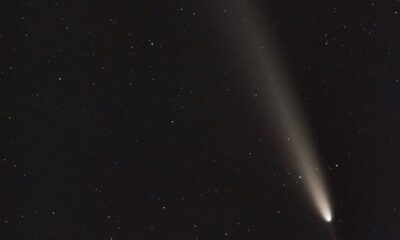
A remarkable visitor from beyond our solar system is captivating astronomers as it journeys through the solar system. The interstellar comet, known as 3I/ATLAS, is exhibiting extraordinary activity, ejecting vivid jets and a substantial gas cloud. This phenomenon provides scientists with a unique opportunity to study material from a distant part of the galaxy, enhancing our understanding of the building blocks of planets.
On 21 July 2025, images captured by the Hubble Space Telescope revealed a teardrop-shaped cocoon of dust enveloping a solid icy nucleus, a clear indicator of its identity as a comet rather than an asteroid. Follow-up observations determined that the nucleus measures between approximately 440 metres and 5.6 kilometres across. Its size is noteworthy, but its interstellar origin makes 3I/ATLAS a valuable sample of ancient cosmic material.
Significant findings emerged from observations conducted by the James Webb Space Telescope in August 2025. The gas cloud surrounding the comet predominantly consists of carbon dioxide (CO2). While water ice, water vapour, and carbon monoxide (CO) were also detected, the CO2-to-water ratio reached an astonishing 8:1, one of the highest ratios ever recorded for a comet. This unusual chemical composition challenges existing theories about cometary formation.
Earth-based telescopes contributed further insight, revealing weak emissions of cyanide (CN) in the emerging coma, along with a notable depletion of carbon-chain molecules compared to typical solar system comets. Such findings suggest that the nucleus of 3I/ATLAS has been subjected to intense cosmic-ray exposure over billions of years, consistent with its deep interstellar origins.
The international astronomical community has mobilized to observe 3I/ATLAS. Probes from both NASA and the European Space Agency (ESA), including the Lucy Spacecraft, MAVEN, and the Mars Reconnaissance Orbiter (MRO), have contributed imagery and data as the comet traverses its path past Mars and the Sun. In October 2025, 3I/ATLAS reached its closest approach to Mars, approximately 30 million kilometres away, allowing orbiters to capture ultraviolet images of its coma.
On 19 November 2025, NASA hosted a livestreamed event to unveil findings about the comet after a delay caused by a US government shutdown. Observations indicate that comets originating from within our solar system carry the chemical fingerprints of the early Sun’s environment. In contrast, 3I/ATLAS offers a direct sample from another star system, potentially reflecting formative conditions that differ from our own.
According to a statement from NASA, current observations confirm that 3I/ATLAS is indeed a comet and not an alien spacecraft, but its scientific value is extraordinary. NASA scientist Amit Kshatriya remarked, “It looks and behaves like a comet … but this one came from outside our solar system, which makes it fascinating, exciting, and scientifically very important.”
As 3I/ATLAS continues its journey, it is expected to make its closest approach to Earth on 19 December 2025, at a distance of approximately 270 million kilometres (about 170 million miles). This distance is considered safe, yet it will still allow ground-based and space-based telescopes to gather more data as the comet heads back into interstellar space. The ongoing observations of this celestial marvel promise to unlock new insights into the origins of our solar system and beyond.










Belfast Gears Up for Vibrant St Patrick’s Day Parade on March 17

Cuba Faces Nationwide Blackout Amid Deepening Energy Crisis

Wirral Council to Restructure Leadership, Cutting Two Top Roles

Rethinking Resistance Training: Key Insights from US Experts

EU Membership on the Horizon: What It Means for Citizens

Ukrainian Drone Swarms Strike Moscow Region for Second Day

Henley Launches Innovative Initiative to Boost Local Economy

Court Ruling Allows Pandemic Tax Refund Claims Until 2026

Sean Penn’s Absence at 2026 Oscars Sparks Discussion

Coronation Street’s Shocking Murder Twist Reveals Family Secrets

Andrew Pierce Confirms Departure from ITV’s Good Morning Britain

Katie Price Faces New Health Concerns After Cancer Symptoms Resurface

Gyles Brandreth Shares Grandson’s Cancer Battle and Recovery

Sue Radford Reveals Weight Loss Journey, Shedding 12–13 kg

Kate Garraway Sells £2 Million Home Amid Financial Struggles

Jordan Brook Faces Health Crisis in Hospital as Sophie Kasaei Stays Away

EastEnders’ Nicola Mitchell Faces Unexpected Pregnancy Crisis

Reddit Study Reveals Distinctions Between Lurkers and Power Users
-
 World9 months ago
Coronation Street’s Shocking Murder Twist Reveals Family Secrets
-
 Entertainment9 months ago
Andrew Pierce Confirms Departure from ITV’s Good Morning Britain
-
 Health12 months ago
Katie Price Faces New Health Concerns After Cancer Symptoms Resurface
-
 Health7 months ago
Gyles Brandreth Shares Grandson’s Cancer Battle and Recovery
-
 Health7 months ago
Sue Radford Reveals Weight Loss Journey, Shedding 12–13 kg
-
 Entertainment1 year ago
Kate Garraway Sells £2 Million Home Amid Financial Struggles
-
 Entertainment5 months ago
Jordan Brook Faces Health Crisis in Hospital as Sophie Kasaei Stays Away
-
 World10 months ago
EastEnders’ Nicola Mitchell Faces Unexpected Pregnancy Crisis
-
 Science9 months ago
Reddit Study Reveals Distinctions Between Lurkers and Power Users
-

 World9 months ago
Mother Charged After Son, 9, Killed in Tragic Incident in Italy
-

 Entertainment12 months ago
Ann Ming Reflects on ITV’s ‘I Fought the Law’ Drama
-

 Entertainment7 months ago
Selena Gomez’s Name Linked to Epstein: Examining the Claims