
Science
Researchers Discover Milky Way Lookalike Galaxy 12 Billion Light-Years Away

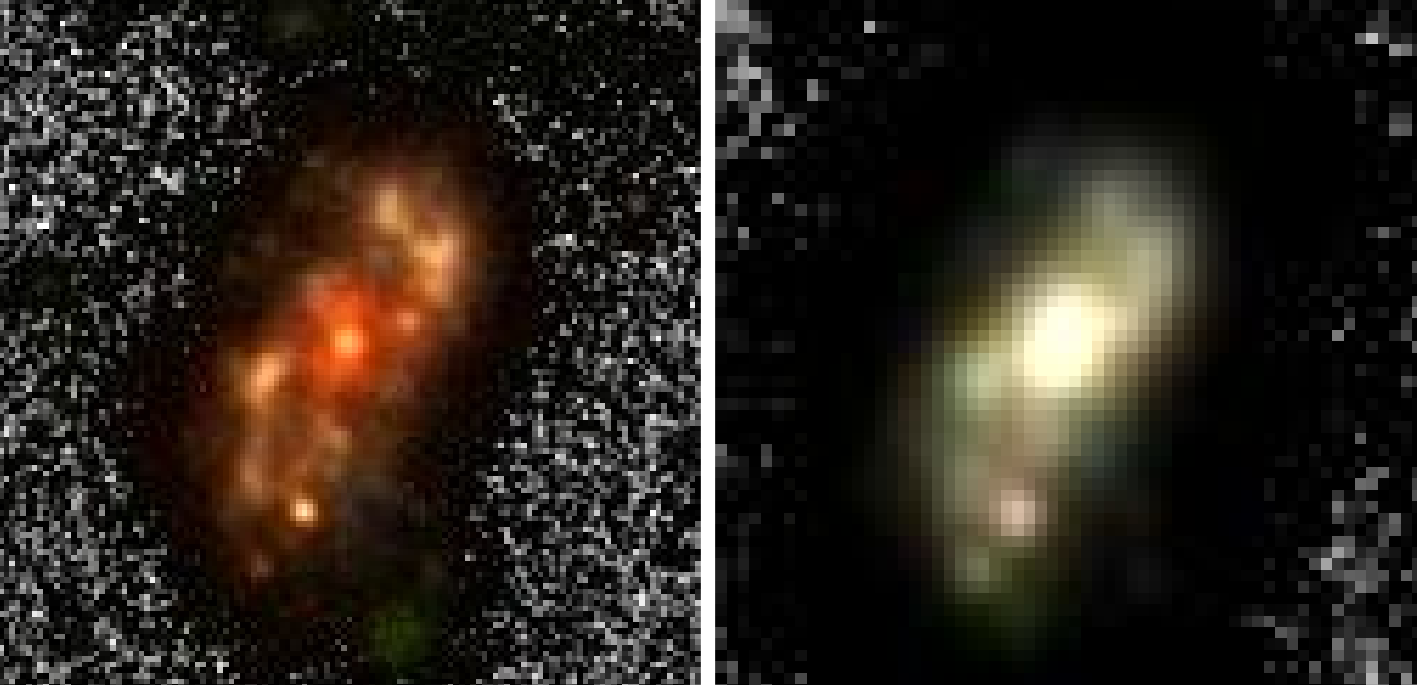
Astronomers have identified a large spiral galaxy named Alaknanda, located approximately 12 billion light-years from Earth. This discovery, made using the James Webb Space Telescope, reveals a galaxy that formed just after the Big Bang, when the universe was around 1.5 billion years old. Alaknanda’s structure challenges previous assumptions that early galaxies were too chaotic to develop into orderly forms.
Researchers have long believed that in the early universe, young stars and gas moved in a tumultuous manner, resulting in irregular clumps rather than structured spiral shapes. Observations from the Hubble Space Telescope had supported this view, suggesting that spiral galaxies were increasingly rare beyond 11 billion years in look-back time. The identification of Alaknanda raises significant questions about galaxy formation processes during this period.
Yogesh Wadadekar, co-author of the study from the National Centre for Radio Astrophysics at the Tata Institute of Fundamental Research in India, stated, “Alaknanda reveals that the early universe was capable of far more rapid galaxy assembly than we anticipated.” He noted that this galaxy has managed to accumulate 10 billion solar masses of stars into a well-defined spiral disk in a remarkably short span of just a few hundred million years.
Significant Findings from the Early Universe
The discovery of Alaknanda is part of ongoing research published in the journal Astronomy & Astrophysics. The James Webb Space Telescope has recently unveiled several disk-shaped galaxies, including Alaknanda, earlier than previously predicted by existing models. In 2023 and 2024, the telescope also identified two other spiral galaxies, CEERS-2112 and REBELS-25, from the early universe.
Using gravitational lensing, a natural phenomenon where a massive galaxy cluster magnifies the light of more distant objects, researchers were able to observe Alaknanda in remarkable detail. This allowed scientists to discern its flat, rotating disk and two smooth, symmetrical spiral arms, a configuration that characterizes a “grand-design” spiral galaxy. Observations reveal chains of bright clumps of newborn stars along the spiral arms, indicating regions where gas has collapsed into dense pockets, igniting new stars.
The star formation rate in Alaknanda is astonishing, with new stars forming at a rate equivalent to about 63 solar masses per year. This rate is significantly faster than the current star formation rate in the Milky Way, which raises further questions about the mechanisms driving such rapid galaxy evolution.
Implications for Galaxy Formation Theories
Research into Alaknanda’s stellar population suggests that its stars average only about 200 million years old, with roughly half formed in a rapid burst after the universe had already exceeded one billion years. To estimate the galaxy’s age, the research team compared its brightness across 21 different wavelengths of light, spanning ultraviolet to infrared.
The findings suggest that the physical processes responsible for galaxy formation—such as gas accretion and disk settling—might operate more efficiently than current models predict. As Rashi Jain, the lead author of the study, explained, “It’s forcing us to rethink our theoretical framework.”
Alaknanda, named after a river in the Himalayas that is a twin headstream of the Ganga, spans approximately 32,000 light-years across, comparable to large modern spiral galaxies. The presence of a small neighboring galaxy may have contributed to the development of Alaknanda’s spiral structure, although further evidence is necessary to confirm this.
Future observations using the James Webb Space Telescope, alongside radio telescopes, may provide insight into the dynamics of Alaknanda’s stars and gas. This could help ascertain whether its disk has reached its final configuration or if the spiral arms represent only a transitional phase in its development.
The discovery of Alaknanda marks a significant step forward in our understanding of galaxy formation in the early universe, highlighting the potential for new revelations as technology continues to advance.









AI-Powered Facial Treatment Reveals Skin Needs Beyond Aging

Education Ministry Files Eight Criminal Complaints Over Fake Diplomas

Surrey Police Launches Crackdown on Drink and Drug Driving

Researchers Discover Milky Way Lookalike Galaxy 12 Billion Light-Years Away

Local Leaders Urge Dialogue to Ease Tensions in Botun

Paul Scholes Criticizes Ruben Amorim Over Kobbie Mainoo’s Role

Driver Banned After Striking 84-Year-Old Near Sainsbury’s in Ballymena

River Island Launches Affordable High-Neck Mesh Midi Dress

African Leaders Urge Immediate Release of Guinea-Bissau Election Results

Ann Ming Reflects on ITV’s ‘I Fought the Law’ Drama

Kate Garraway Sells £2 Million Home Amid Financial Struggles

Katie Price Faces New Health Concerns After Cancer Symptoms Resurface

Coronation Street Fans React as Todd Faces Heartbreaking Choice

Coronation Street’s Carl Webster Faces Trouble with New Affairs

Where is Tinder Swindler Simon Leviev? Latest Updates Revealed

Bailey Announces Heartbreaking Split from Rebecca After Reunion

Markiplier Addresses AI Controversy During Livestream Response

Brian Cox Addresses Claims of Alien Probe in 3I/ATLAS Discovery
-
 Entertainment3 months ago
Ann Ming Reflects on ITV’s ‘I Fought the Law’ Drama
-
 Entertainment4 months ago
Kate Garraway Sells £2 Million Home Amid Financial Struggles
-
 Health3 months ago
Katie Price Faces New Health Concerns After Cancer Symptoms Resurface
-
 Entertainment3 weeks ago
Coronation Street Fans React as Todd Faces Heartbreaking Choice
-
 Entertainment3 months ago
Coronation Street’s Carl Webster Faces Trouble with New Affairs
-
 Entertainment3 months ago
Where is Tinder Swindler Simon Leviev? Latest Updates Revealed
-
 World3 weeks ago
Bailey Announces Heartbreaking Split from Rebecca After Reunion
-
 Entertainment4 months ago
Markiplier Addresses AI Controversy During Livestream Response
-
 Science2 months ago
Brian Cox Addresses Claims of Alien Probe in 3I/ATLAS Discovery
-

 Health5 months ago
Carol Vorderman Reflects on Health Scare and Family Support
-

 Entertainment4 months ago
Kim Cattrall Posts Cryptic Message After HBO’s Sequel Cancellation
-

 Entertainment3 months ago
Olivia Attwood Opens Up About Fallout with Former Best Friend