
Science
ESA’s Juice Captures Stunning Insights from Comet 3I/ATLAS

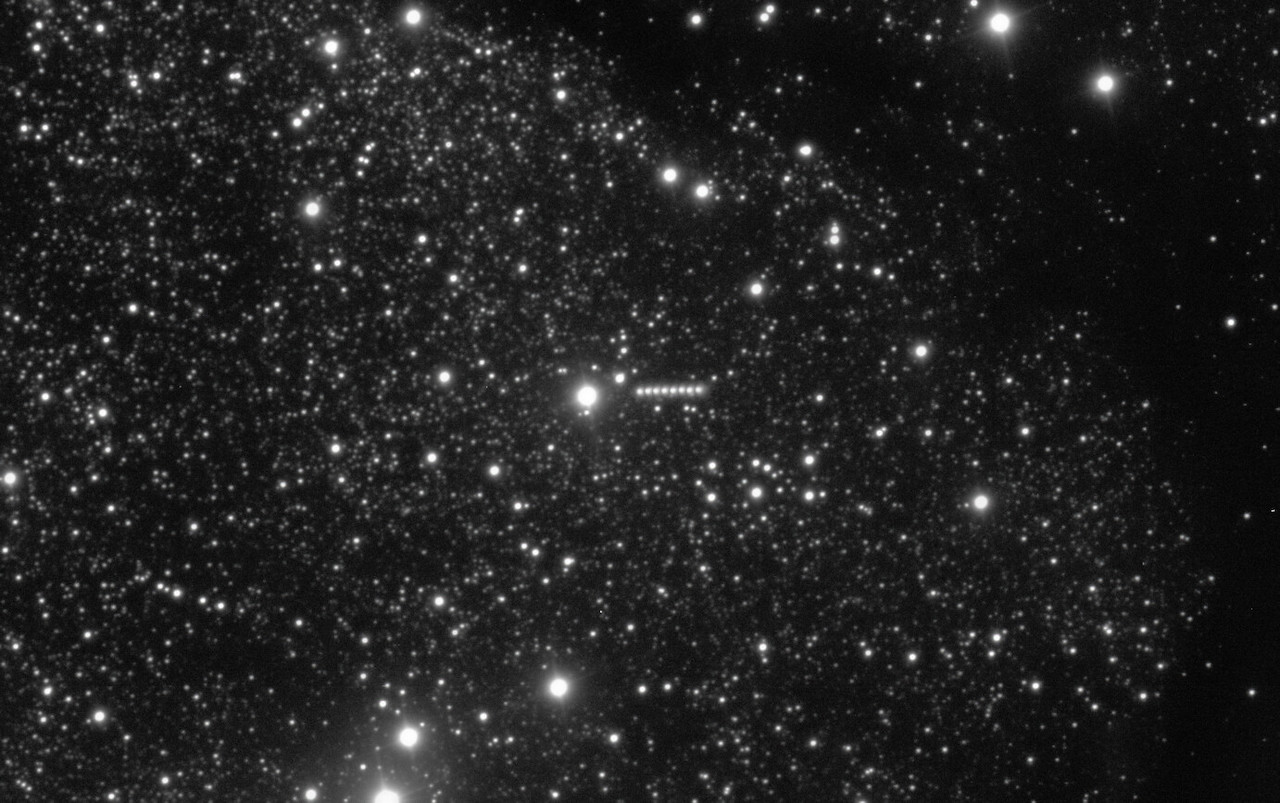
A remarkable alignment in space has allowed the European Space Agency’s (ESA) Jupiter Icy Moons Explorer, known as Juice, to observe the interstellar comet 3I/ATLAS during a rare encounter. This event provided scientists with a unique opportunity to study the comet’s volatile nature, marking a significant milestone in astronomical research. The first tantalizing image of 3I/ATLAS, captured by Juice’s Navigation Camera, has revealed dramatic signs of activity, heightening anticipation for the comprehensive data set expected in early 2026.
The comet, first detected by the ATLAS (Asteroid Terrestrial-impact Last Alert System) telescope network on July 1, 2025, is only the third interstellar object ever identified. Astronomers confirmed its interstellar origin through calculations of its orbital eccentricity, estimated at an extraordinary 6.139. This high value indicates that 3I/ATLAS is moving too swiftly and on a hyperbolic trajectory, confirming it is not bound to the Sun and has journeyed from another star system.
During a critical observation period in November 2025, Juice used its advanced scientific instruments—JANUS, MAJIS, UVS, SWI, and PEP—to closely monitor the comet. These instruments provided valuable insights into the comet’s behavior and composition. The closest approach occurred on November 4, when 3I/ATLAS was about 66 million km from Juice, just days after the comet reached its perihelion, or closest point to the Sun, on October 29, 2025. At this moment, the comet was at its most active, exhibiting significant outgassing.
Juice faced challenges during these observations, including the need to limit exposure to solar radiation. The spacecraft could only observe the comet directly for a maximum of 30 minutes each day. Despite these constraints, the initial image from the Navigation Camera provided a striking glimpse of the comet’s activity. The low-resolution image confirmed the comet’s visibility and showed signs of its dynamic nature, including a glowing halo of gas known as a coma, and hints of two distinct tails: a prominent plasma tail and a fainter dust tail.
The release of the full data set is delayed due to the spacecraft’s current protective maneuver. Juice is utilizing its main high-gain antenna as a heat shield to safeguard its instruments from solar radiation, resulting in a slower data transmission rate through its smaller medium-gain antenna. The complete data from the five scientific instruments is expected to be transmitted on February 18 and 20, 2026.
Scientists are eager for the forthcoming data, as it will provide deeper insights into the comet’s characteristics during its active phase. The datasets will include high-resolution optical images from JANUS, spectrometry data from MAJIS and UVS, composition analysis from SWI, and particle data from PEP. Collectively, these measurements will help unravel the chemical makeup of 3I/ATLAS and deepen our understanding of its origins.
This exceptional encounter with 3I/ATLAS offers a rare opportunity to examine the ancient chemistry of an object from outside our solar system. While the wait for the detailed data continues, the preliminary observations have already confirmed that this interstellar visitor is actively shedding material, providing critical insights into the processes that govern planetary formation across the galaxy. The findings promise to unlock new mysteries about the universe we inhabit.













Belfast Gears Up for Vibrant St Patrick’s Day Parade on March 17

Cuba Faces Nationwide Blackout Amid Deepening Energy Crisis

Wirral Council to Restructure Leadership, Cutting Two Top Roles

Rethinking Resistance Training: Key Insights from US Experts

EU Membership on the Horizon: What It Means for Citizens

Ukrainian Drone Swarms Strike Moscow Region for Second Day

Henley Launches Innovative Initiative to Boost Local Economy

Court Ruling Allows Pandemic Tax Refund Claims Until 2026

Sean Penn’s Absence at 2026 Oscars Sparks Discussion

Coronation Street’s Shocking Murder Twist Reveals Family Secrets

Andrew Pierce Confirms Departure from ITV’s Good Morning Britain

Katie Price Faces New Health Concerns After Cancer Symptoms Resurface

Gyles Brandreth Shares Grandson’s Cancer Battle and Recovery

Sue Radford Reveals Weight Loss Journey, Shedding 12–13 kg

Kate Garraway Sells £2 Million Home Amid Financial Struggles

Jordan Brook Faces Health Crisis in Hospital as Sophie Kasaei Stays Away

EastEnders’ Nicola Mitchell Faces Unexpected Pregnancy Crisis

Reddit Study Reveals Distinctions Between Lurkers and Power Users
-
 World8 months ago
Coronation Street’s Shocking Murder Twist Reveals Family Secrets
-
 Entertainment8 months ago
Andrew Pierce Confirms Departure from ITV’s Good Morning Britain
-
 Health11 months ago
Katie Price Faces New Health Concerns After Cancer Symptoms Resurface
-
 Health6 months ago
Gyles Brandreth Shares Grandson’s Cancer Battle and Recovery
-
 Health6 months ago
Sue Radford Reveals Weight Loss Journey, Shedding 12–13 kg
-
 Entertainment12 months ago
Kate Garraway Sells £2 Million Home Amid Financial Struggles
-
 Entertainment5 months ago
Jordan Brook Faces Health Crisis in Hospital as Sophie Kasaei Stays Away
-
 World9 months ago
EastEnders’ Nicola Mitchell Faces Unexpected Pregnancy Crisis
-
 Science8 months ago
Reddit Study Reveals Distinctions Between Lurkers and Power Users
-

 World9 months ago
Mother Charged After Son, 9, Killed in Tragic Incident in Italy
-

 Entertainment11 months ago
Ann Ming Reflects on ITV’s ‘I Fought the Law’ Drama
-

 World9 months ago
Bailey Announces Heartbreaking Split from Rebecca After Reunion